PRESS: MODERN FARMHOUSE
MODERN FARMHOUSE FEATURED IN MOUNTAIN LIVING MAGAZINE
JUNE 28, 2021
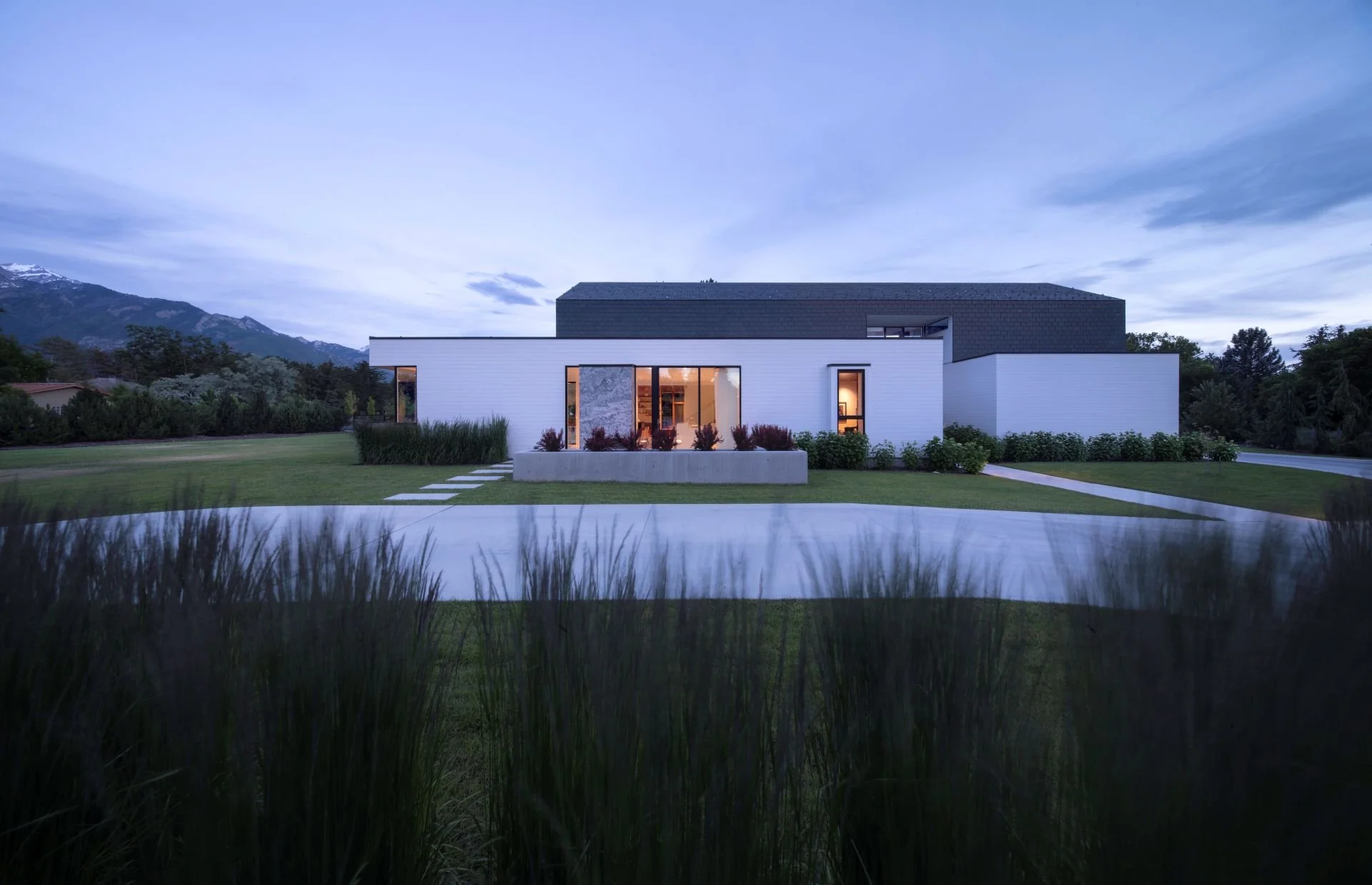
Discussions of a large farmhouse on a sprawling piece of land don't normally conjure up images of modern architecture, but we embrace the challenge of pushing this envelope. A good case in point is the Modern Farmhouse we recently designed for a client on land at the edge of the Salt Lake Valley.
We are extremely honored that this new home was featured in Mountain Living Magazine and has won design awards including an AIA Utah design award in 2020. It is pleasing to know that, in addition to making our clients happy, we have earned the accolades of our peers. This reinforces the idea that we are doing something right here at Sparano + Mooney Architecture.
CONTEMPORARY MEETS VERNACULAR ARCHITECTURE
The Modern Farmhouse sits on a rare parcel of land that was once a horse farm. Framed by dramatic Wasatch peaks behind it, the home is pure Utah from top to bottom. We saw the site and knew we could make this home something truly spectacular. By combining contemporary design with vernacular architecture, we knew that we could create a home perfectly suited to its natural environment.
In terms of materials, we wanted to ensure the home reflected the history of local home construction. For example, consider the horizontal wood siding. It speaks to the wood cladding of so many historic barns and farm houses from days gone by. The home's roof line even resembles a classic barn from a distance.
Landscaping was kept to a minimum to reflect the wide-open spaces needed by a traditional horse ranch. Horses and livestock need room to roam, so we took advantage of that to create wide-open exterior spaces that offer sweeping views in nearly every direction.
MODERN INTERIOR SPACES
The vernacular nature of the home's exterior in no way contrasts with a fully modern interior design. We chose a contemporary design expression that focuses on open spaces, straight lines, and simple color palettes. Of course, fantastic views of the Wasatch Mountains had to be incorporated. That's why you'll find floor-to-ceiling windows framing spectacular views throughout the home.
Balancing public and private spaces were of the upmost importance to our clients. In addition, the family’s strong musical background indicated the need for a dedicated music space. We were able to seamlessly incorporate these spaces into the home to fit the clients’ needs.
This home with 5,500 square feet of living space boasts four bedrooms in total. The first floor offers an open-floor concept with connected kitchen, dining area, and entertaining spaces. The main living area flows effortlessly into the music space without sacrificing any lines of sight.
PASSIVE DESIGN INCLUDED
Another priority for this design was passive and energy efficient design. In the early stages, we employed solar modeling to determine how natural light would impact with the home at various times throughout the year. We were able to use our digital models to take full advantage of the sun's path to maximize a solar design strategy for the architecture.
At the same time, we wanted to situate the home on the land in such a way as to maintain breathtaking views while still maximizing passive design. The great room offers an unobstructed Mt. Olympus view perfectly illuminated by the morning sun.
We truly appreciate the opportunity to have worked with our client to create this one-of-a-kind home. It is a demonstration of just what can be accomplished when architects and property owners think outside the box. If you would like to learn more about this home, we invite you to take a look at the feature in Mountain Living Magazine.

VERNACULAR + MODERN ARCHITECTURE
VERNACULAR ARCHITECTURE INSPIRES MODERN HOMES IN PARK CITY, UT
JUNE 14, 2021

Different architectural movements have defined building styles throughout the ages. One of our favorites is modernism, a movement that began in earnest in the 1930s. Fast forward more than 90 years and we are seeing a new trend here in Utah: a return to vernacular architecture: inspiring new, modern houses throughout Park City.
Those that live outside Utah mostly know this part of the state as home to multiple renowned ski resorts. They are familiar with the fact that nearby Sundance attracts the rich and famous for both skiing and the annual film festival, but they don't know a lot about our architectural history.
Knowledge of local history is important because vernacular architecture is so wrapped up in it. As it inspires architecture in Park City, Utah's rich history is being revisited in the homes people build here.
VERNACULAR ARCHITECTURE EXPLAINED
The beauty of vernacular architecture is that it isn't necessarily inspired or defined by a particular movement. Its defining characteristic is the fact that, historically, vernacular homes were built without the services of an architect. Builders drew from their own knowledge and whatever local resources they had available to construct simple, modest homes.
It has been suggested that the majority of older homes in Utah, and across the country for that matter, are vernacular homes. Though never proven, the assumption sounds reasonable. These days, we are attempting to re-create vernacular architecture in look and feel even while involving architects in new home design.
RELIGIOUS + SECULAR LANDSCAPES
By definition, vernacular architecture is different from one region to the next. Here in Utah, things are divided into two geographic categories: religious and secular landscapes. The former revolves around the great Salt Lake Valley and Jordan River areas. The latter are found in the northern areas of the state. Here in Park City, our region is considered part of the secular landscape.
Our local history is heavily rooted in pre-industrial uses of the Wasatch Mountains. Before the mountains hosted entire resort communities, this area was populated with hunters, trappers and miners, which were all big industries then. As such, the vernacular architecture of a hundred years ago was essentially a combination of ski lodges and hunting cabins.
Park City architects that tap into that history design modern homes inspired by yesterday's vernacular styles. We are designing homes that capture the essence of what it meant to live in Utah, before Sundance became a destination of the rich and famous. These are homes that, while they might feature modern amenities and state-of-the-art construction, still offer the feel of relaxed modesty.
THE BEST OF OLD + NEW
One of the things we most appreciate about vernacular architecture is its perfect suitability to passive design. Our architects specialize in passive design, which is the practice of designing homes in such a way as to limit dependence on mechanical heating and air conditioning.
Passive design was a way of life before we had forced air heating and AC. In a place like Northern Utah, where access to dependable power would have been limited a hundred years ago, you had to build your home to take advantage of passive heating and cooling.
Designing custom homes for Park City residents is truly satisfying, and we love what we do. And now, designing local homes is even more enjoyable thanks to the resurgence of vernacular architecture. Through it, we are given the opportunity to revisit some of Utah's rich history in our new designs.
NATURAL MINIMALISM
MINIMALISM IN ARCHITECTURE: A Better Approach for Natural Sites
MAY 31, 2021
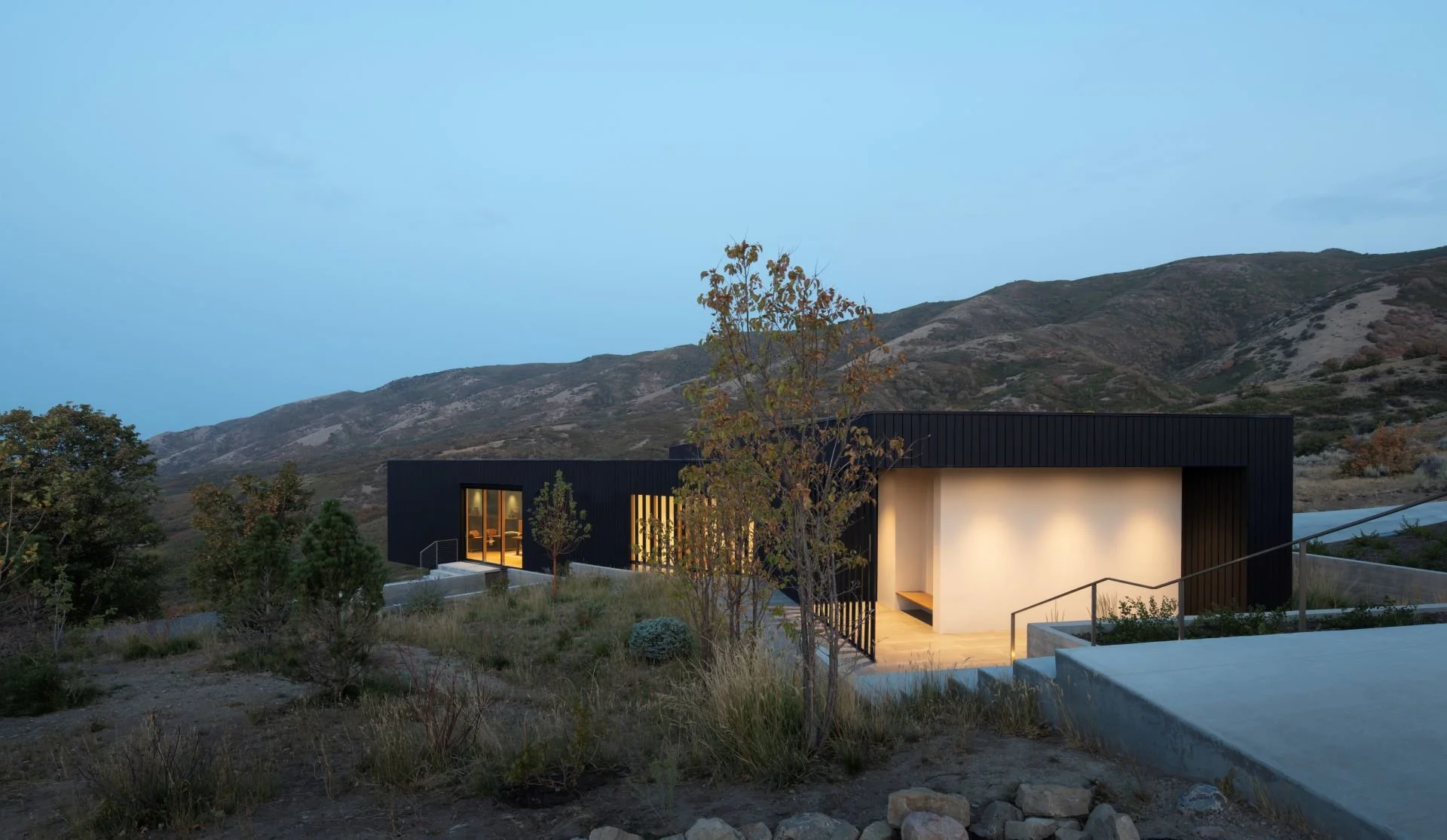
Minimalism is not new in architecture. It has been employed in various forms throughout history. Yet now, it is almost becoming a movement of its own. The architectural world is gradually discovering that minimalism is a more fitting approach for natural sites.
Well-known architects like Alberto Campo Baeza and John Pawson are creating some truly inspirational designs with minimalism at the core. Campo Baeza's Zalamea la Real, on the outskirts of Huelva, Spain is a classic example. The home is built on a hillside site surrounded by beautiful scrub lands. The home's simplicity fits perfectly with the surrounding area.
LESS IS MORE
The central theme of minimalism in architecture is best encapsulated in Ludwig Mies van der Rohe's philosophy that less is more. Van der Rohe was a well-known German-American architect whose work heavily influenced American architecture in the years immediately following World War I. He believed that ornamentation, for its own sake, was both unnecessary and unfitting to modern design.
He was so passionate in his dislike for ornamentation that he once called it a 'crime'. Although we may not go that far these days, minimalism in 2021 still strives to keep things simple and free of superfluous ornamentation.
LETTING NATURE BE NATURAL
Building on a natural site offers challenges that can differ quite a bit from building in urban environments. For instance, natural undeveloped sites require a sensitive approach to design. Designing new architecture for these sites requires considering what will happen to the environment once construction starts. How the structure will work harmoniously with the site post-construction is also key.
Letting nature be nature is a key concept of minimalist architecture on natural sites. You can see examples in many of our mountain modern architectural homes. Where minimalism is embraced, homes have a minimal impact on the surrounding environment. Equally important, they are unobtrusive and celebrate their surroundings.
Minimalism keeps the focus on the natural environment. Whether it is the views of the Wasatch Mountains or scrublands in Spain, nature is still the dominant feature. The minimalist approach seeks to ensure that new structures do not take over.
EXPOSING THE TRUE ESSENCE
A core principle of minimalism is that simplicity reveals architecture's true essence. We like to take this one step further. Minimalism on natural sites reveals the true essence of the natural world. By keeping things basic, simple, and free of ornamentation, we create homes that reveal just how incredible a natural context really is.
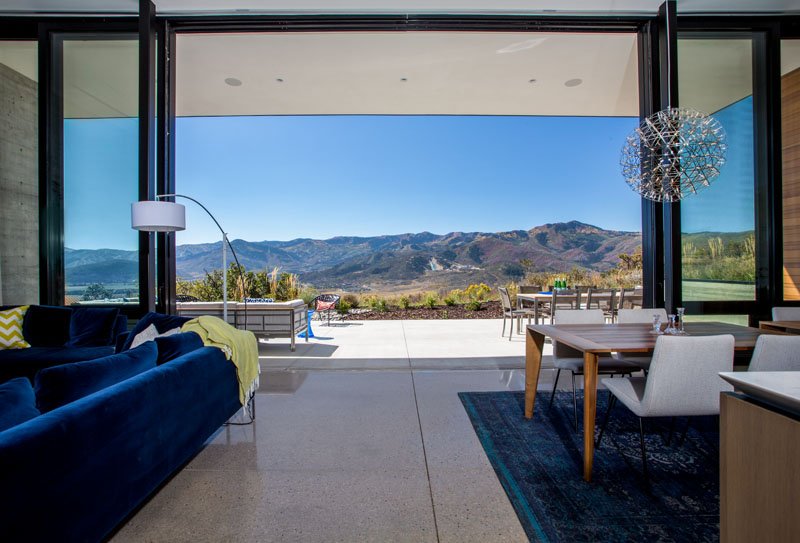
One of the ways we do that is to incorporate a generous views and indoor/outdoor connections. Of course, views are top priority, but it design can be much more than that. Floor-to-ceiling glass blurs the lines between interior and exterior spaces. Wide-open views throughout the day and night bring nature into the home. Meanwhile, all nature has to offer lies just outside.
The desire to connect natural and human-made elements organically leads to other things. It suggests that we rely on locally sourced building materials as much as possible. It suggests that we incorporate passive design strategies in the architecture to minimize dependence on mechanical heating and cooling.
MINIMALISM IN UTAH ARCHITECTURE
Architects take inspiration from many places and formal expression varies widely around the world. Furthermore, everyone from property owners to architects and interior designers has their own preferences. From our perspective, here in Park City, minimalism seems to be one of the best approaches for designing within natural spaces.
If you like the idea of minimalist architecture on natural sites, we have plenty of experience with both. Let's talk about building your new home with a minimalist approach to the architecture and ways to celebrate Utah's fantastic natural environment at the essence of design.

CONTEMPORARY HOME DESIGN
WHAT DO YOU LIKE MOST ABOUT CONTEMPORARY HOME DESIGN?
APRIL 19, 2021
Contemporary design is something we specialize in at Sparano + Mooney. There is just something about this type of design that evokes positive emotions we don't associate with other architectural styles.
What do clients love so much about contemporary home design? Each of our architects have personal preferences, but they may differ from the client's. We go out of our way to meet each client's expectations and, when we can, exceed them to the greatest possible extent. As a Sparano + Mooney client, how can we best help you? What do you most like about contemporary home design?
ITS PERIOD-AGNOSTIC NATURE
One of the unique characteristics of contemporary design is what we refer to as being 'period-agnostic'. In other words, true contemporary design does not present any distinct links to any given time periods. It may draw in a few elements of previous design periods, but the way those elements are incorporated into the overall design creates a design that is simply in the moment.
True contemporary design does not look too heavily to the past. Nor does it attempt to create an image of the future. Contemporary design is what people envision in the very times in which they live.
ITS CLEAN LOOK
Because contemporary design is in the moment, it is constantly evolving. This forces us to look at what is currently considered contemporary to understand what clients appreciate about it. For you, it might be contemporary design's clean look.
A clean look can be accomplished, architecturally, in a number of ways. For example, straight lines do not constantly draw your attention like curves, angled lines, etc. Straight lines let your eyes take in the entire space without distraction.
We can also accomplish a clean look with simple variations in color and texture. The more subtle the variations, the cleaner the look. This is why many contemporary homes feature minimal decoration and color schemes based in grays and off-white.
ITS WIDE-OPEN SPACES
Wide open spaces are another hallmark of modern contemporary design. At this point in history, we don't like to be cooped up in small rooms filled with lots of furniture and trappings that make us feel closed in. We like large rooms with lofty ceilings and plenty of windows.
Fortunately, the Park City area is a wonderful place to build large, contemporary homes with wide-open spaces that maximize views. There may be no better locale in all of Utah for contemporary home design. We hope you will consider that if you are planning to build a home in the Beehive State.
ITS EMPHASIS ON EFFICIENCY
For some of our clients, the most attractive aspect of contemporary design is its emphasis on efficiency. Modern homeowners want homes that are LEED certified and are built around passive design principles. Both are key to contemporary design in the 21st century.
You may have your own reasons for loving contemporary design, and we would love to help you build the contemporary home of your dreams in Park City. Whether you plan to build a vacation home or move here permanently, the Sparano + Mooney design team looks forward to working with you.
HIRING A PARK CITY ARCHITECT
THE BENEFITS OF HIRING AN ARCHITECT LOCAL TO PARK CITY
APRIL 05, 2021
If building a ski lodge in the Park City, Utah area has been a dream of yours for years, and you’re finally ready to take the plunge, your first step is hiring an architect. With so many choices, we recommend hiring one local to the Park City area, and Sparano + Mooney is a great choice.
Hiring an architect local to Park City is a smart move, as local firms bring things to the table that out-of-town firms do not. And while those other firms still have things to offer, having a local connection just can't be beat.
LOCAL FIRMS KNOW LOCAL LAND
If you hire your architect first, you won’t have a piece of land picked out or purchased yet. A local firm can offer advice on the best places in Park City to build. A lot of local firms have connections with builders and real estate agents as well, and you could get a leg up on the most desirable properties currently on the market.
Along those same lines, locally architects know how to use the plot of land you choose to maximum design advantage. They understand how the local environment plays into accomplishing your design goals. An out-of-town firm may not have that level of understanding of the local Utah environment.
LOCAL FIRMS KNOW LOCAL REGULATIONS
When it comes time to start the design phase, there are going to be local and state regulations to consider. An out-of-town firm based elsewhere in Utah may be completely familiar with state regulations and still lack knowledge of regulations local to Park City. This could make an enormous difference.
LOCAL FIRMS KNOW LOCAL RESOURCES
Next, local firms are intimately familiar with the resources available to them. For instance, mountain modern architecture is big in the Park City area. One of the more important aspects of mountain modern is sourcing local materials whenever possible. Building with local materials ensures that a home appears to flow from the surrounding environment rather than having been placed in it.
As local architects, we are intimately familiar with the surrounding area and the resources available to builders. We can design with that knowledge base as our foundation.
LOCAL KNOWLEDGE ENHANCES PASSIVE DESIGN
If you are looking for your new ski lodge to follow passive design principles, you really need a local architectural firm. The basics of passive design are consistent all across the country. However, the local environment influences passive design in subtle ways that may not be understood by out-of-town designers.
Passive design is a principle that seeks to reduce dependence on mechanical heating and cooling by utilizing what the surrounding environment has to offer. Passive design relies on an understanding of local temperatures, weather patterns, and even how the sun travels across the sky in relation to the property on which the home is being built.
LOCAL IS USUALLY BETTER
Local designers know what it's like to live here, and they fully understand the Park City environment in ways that someone who does not live here cannot. We feel that this is important to designing and building a custom home. If you are thinking of building a new home in the Park City area, we would be honored by the privilege to work with you.
SUSTAINABLE ARCHITECTURE
5 THINGS WE APPRECIATE ABOUT SUSTAINABLE ARCHITECTURE
MARCH 22, 2021
Sparano + Mooney is known throughout the Park City area for mountain modern architecture. We are also known for our passive design and ability to work within LEED guidelines and standards. Yet there is something else we are passionate about: sustainable architecture.
The concept of sustainable architecture doesn't get a lot of press. This is unfortunate because designing homes around sustainability is good for everyone. We believe sustainable homes are the way to go, not only in our little corner of Utah, but also everywhere houses are built. We would be honored to help design your new sustainable vacation or permanent home in the Park City area.
So, why do we appreciate sustainable architecture? Here are five things to consider:
1. HISTORY
We tend to think of sustainability as a modern construct, and it is to a certain degree, given that much of what we do is defined by a mindset not developed until after the industrial era. We think of sustainability as a contrast to synthetic materials, disposable products, and even the entire consumer paradigm, yet sustainability is a centuries-old practice.
Modern sustainable architecture traces its roots back to the early stages of the Earth Day movement more than 50 years ago. Builders were utilizing sustainable principles before industrialism. Indigenous populations around the world built homes using the natural resources at-hand and with an eye toward protecting their surroundings with every new structure built.
2. LOW IMPACT FOCUS
By its nature, sustainable architecture seeks to have as little impact on the natural environment as possible. This is critical in a state is beautiful as Utah.
We appreciate sustainable architecture because of its low impact focus. We believe it is our responsibility to keep our impact on the natural environment as minimal as possible. Sparano + Mooney designs luxury homes with that in mind. Our homes fit naturally into the environments in which they are found. They are surrounded by nature rather than being cleared of it.
3. ENERGY EFFICIENCY
A hallmark of modern sustainability is energy efficiency. We understand this in two separate ways. First, saving energy means relying less on fossil fuels. The fewer fossil fuels we utilize, the less pollution we spew into the environment. Second, energy efficiency allows us to rely more on renewable power sources like wind and solar. Sustainable architecture emphasizes energy efficiency.
4. LINK TO PASSIVE DESIGN
Hand-in-hand with energy efficiency is passive design. When we design a new passive home in the local area, we utilize what nature has to offer for heating and cooling. Our homes are less dependent on mechanical HVAC, making them more energy-efficient and less reliable on grid energy. The beauty of passive design is that it is simple but effective.
5. POTENTIAL FOR DIFFERENT MATERIALS
Finally, we appreciate sustainable architecture due to its potential for so many different building materials, and we use naturally sourced materials when possible and appropriate. A sustainable mindset isn't afraid to embrace recycled materials, repurposed materials, etc. Every time we can design without having to rely on manufacturing new synthetic materials, we are improving the sustainability of what we do.
We believe sustainability is worth the extra effort and investment. After all, we only have one planet to leave to future generations.
PASSIVE HEATING + COOLING
HOW DO PASSIVE HEATING AND COOLING WORK?
MARCH 15, 2021
Many of our clients building custom homes on the Wasatch Back are interested in building and living in passive homes. Passive design has been around for a long time, and is experiencing a resurgence among architects, builders, and homeowners alike. This design concept is rooted in taking advantage of nature’s ability to heat and cool without relying on mechanical systems as the primary source of temperature control. In this part of the world, well designed passive homes are appreciated in their cost saving ability and in their positive net zero energy environmental impact.
If you are looking to build a new residence or vacation home in the Park City area, a passive design strategy is something to strongly consider. Some of the most beautiful homes in our area are passive homes, and are a more environmentally friendly and sustainable option to alternatives.
TWO WAYS TO HEAT + COOL
Most of what goes into the passive design relates to heating and cooling. In architectural design, there are two ways to heat and cool: mechanically and naturally. Passive homes rely on natural heating and cooling as much as possible. This is not to say there is no room for mechanical systems in passive homes but, rather, to say the need for these systems are minimized as much as possible.
A mechanically heated and cooled home requires a standard HVAC system. A forced air, radiator, or radiant floor system keeps the home warm in the winter while air-conditioning keeps it cool in the summer. In both cases, a significant amount of energy is dedicated to climate control. A passive home is designed to work in harmony with the natural surroundings, thereby mitigating the need for mechanical systems. Architects specializing in passive homes prioritize things such as lot location, tree cover, and orientation in terms of siting and then a well-designed building envelope in the design of a passive house.
UTILIZING THE SUN
From late fall through early spring, a passive home heavily relies on the sun, and uses it to the home’s advantage. The sun becomes the most important heating element. From late spring to early fall however, it is just the opposite. A passive home stays cooler by limiting how much sun penetrates interior spaces.
The angle of the sun is one of the primary considerations when designing a passive home. It shines overhead at the peak of summer but hangs very low in the winter. Passive homes can be designed to block summer sunlight but welcomes in the winter sun. Here are just a few examples of how it works:
Trees – Building a passive home with strategically placed trees surrounding it can reduce its exposure to summer sun. When fall and winter arrives, the leaves fall away and the home is warmed by the winter sun.
Overhangs – Well-designed overhangs adequately block the summer sun when it's overhead, but when the sun sinks lower in the sky, overhangs do not interfere with its ability to warm through the windows. Our digital models calculate the ideal overhang dimensions for each home design.
Insulation – Proper insulation keeps heat in during the winter but out during the summer. No home can be truly passive without suitable insulation and a well-designed tight building envelope.
While the sun is the focal point of passive design, residential architects consider many other elements when designing a passive home, working with experienced architects with a background in sustainability is an important aspect when it comes to designing your passive home.
BENEFITS OF GOING PASSIVE
The benefits of passive design don't stop at energy savings and increased comfort. If you are ready to learn how passive design can make your Park City dream home even better, feel free to reach out to our architects at Sparano + Mooney.
Our passive homes are found throughout the Wasatch Back and throughout the rest of Utah. As experts in passive design, and we would be excited to incorporate this expertise into the design of your new vacation home or mountain residence.
MODERN ON THE MOUNTAIN
MODERN ARCHITECTURE IN MOUNTAIN TERRAIN
MARCH 08, 2021
To an architect, modern architecture includes ideas of passive design, LEED accreditation and sustainability. And although these terms may be familiar to a client, when designing and building a Park City vacation home, one of the most important aspects of modern architecture, is the look, feel, and aesthetics of the space. But when a design term such as “modern” becomes widely used, the meaning can be misconstrued and isn’t always associated with mountain sites.
It can be difficult to blend one's understanding of modern architecture with the beautiful natural surroundings of Utah's Wasatch Back and sites in resort areas like Big Sky, Montana, Sun Valley, Idaho and Jackson Hole, Wyoming. Oftentimes these two seem incompatible. Modern architecture closely associated with metropolitan areas, is not exclusively about flat roofs and expansive glass. Incorporating modern architecture in a natural setting can be so much more.
GREAT DESIGN = MOUNTAIN AESTHETICS
At first glance some aspects of modern design may not fit aesthetically with a rustic, natural environment, and if implemented poorly, can be obtrusive. Implementing a design in a custom build that doesn’t fit in the setting of a mountain home will leave it looking out of place, in the same way a log cabin may look out of place on a tropical beach. However, with the right design strategies, modern architecture can be right at home in a mountain setting.
Architects and clients alike understand that poor design creates poor aesthetics. This is one of the primary reasons we specialize in Mountain Modern architecture in Park City, Powder Mountain, and across the Wasatch Back. This style of architectural design combines modern features with the local environment to create designs that look completely natural. Our goal is always to create something that matches and enhances the natural environment around it.
A MISUNDERSTANDING OF MODERN
Another misunderstanding of modern architecture that creates a rift in the design world is that the style is viewed through the lens of mid-20th century design. In the 70 years since the 1950s, modern architecture has shifted from elements from the past, to looking to the future.
Beyond aesthetics and visuals, modern architecture focuses heavily on sustainability. Mountain Modern architecture goes beyond the basics of sustainability. The goal of the design is to build a home that is easier on the environment, less likely to consume future resources, and is constructed with as many local, renewable and sustainable materials as possible.
When designing modern architecture, we seek to conserve energy through a variety of passive design strategies that minimize the need and use of HVAC systems and are powered by renewable energy sources. Our designs seek to combine indoor and outdoor spaces that redefine how we separate - and connect - the two.
BEAUTIFUL, NATURAL + MODERN
Modern architecture done right ends up looking beautiful, feeling comfortable, and works in connection with the natural environment around it. This is what we strive for in every project we take on, and especially when we get to work with the beauty of Park City and other mountain areas.
Mountain modern architecture should not create obtrusive buildings that in turn degrade the natural surroundings that they exist in. Embracing the natural environment and using it to inform the design is what we strive to bring our clients in both their permanent residences and vacation homes. View our past designs and recent builds on our website, we’d love to help bring your ideas to life.