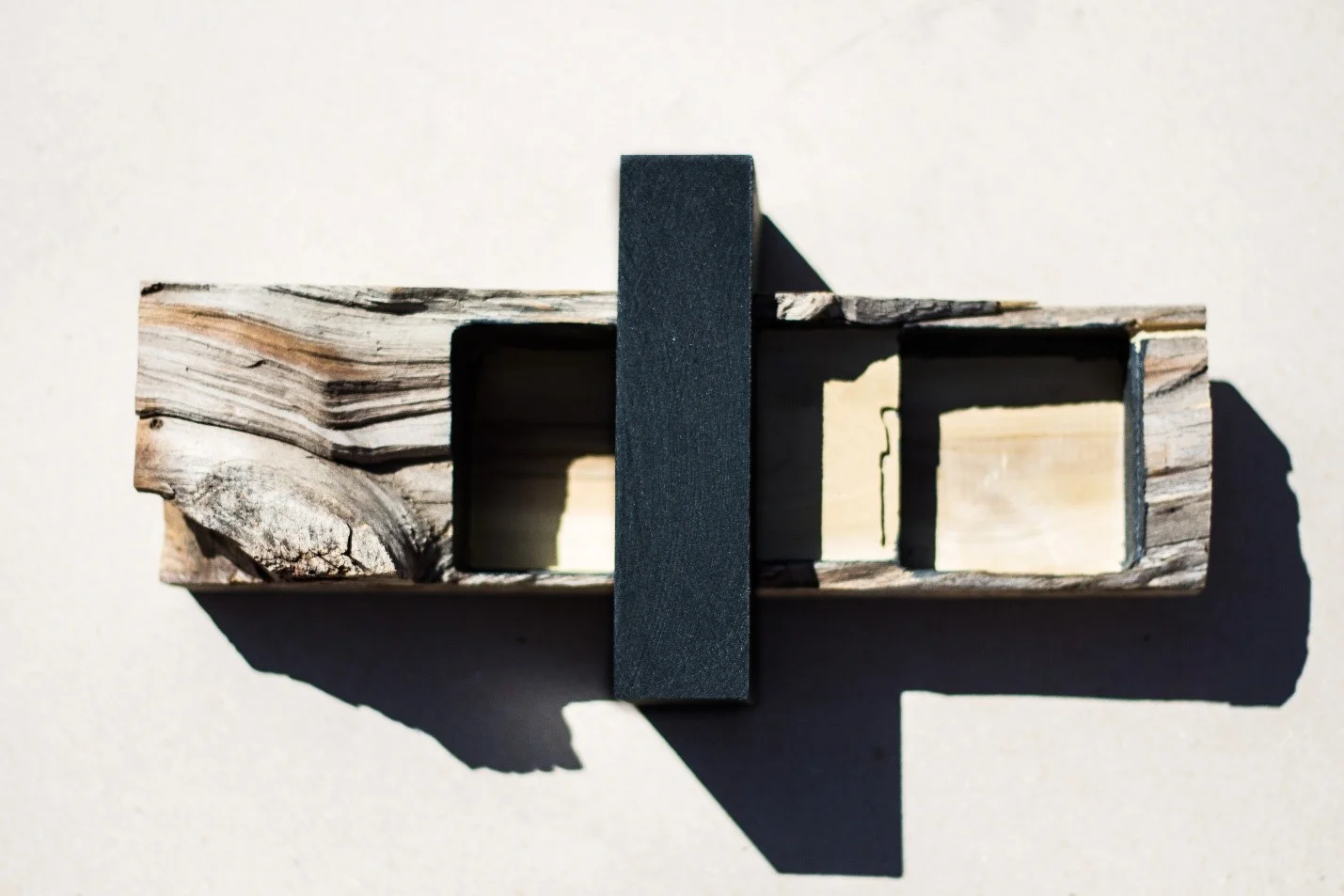
THE BEAUTY OF IMPERFECTION
THE BEAUTY OF IMPERFECTION IN ARCHITECTURE
MAY 01, 2017
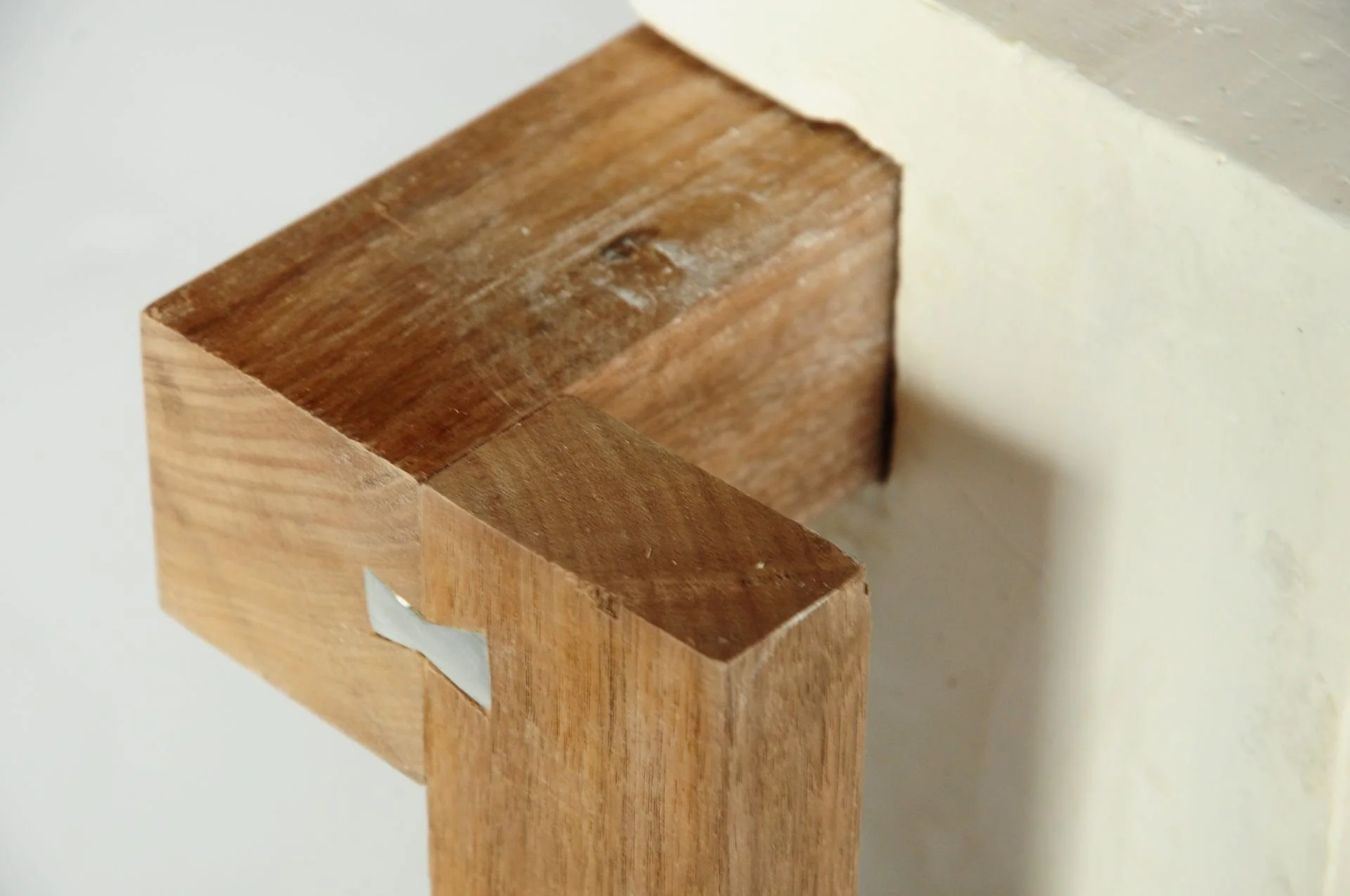
In an era of quick-fix consumerism, it might be tempting to eschew the flawed in favor of the refined. Why mend a broken flower pot when a shiny new model can easily, and cheaply, be acquired from any number of big-box stores that continue to pop up in our neighborhoods? Why refinish 100 year-old wood floors when synthetic, sanitized replacement planks can be laid instead? Well – why not? What is the true cost of this “modern” need to resolve all that is deficient? This is a poignant question, one that hints at a new wave of appreciation for the true and the humble in all facets of life, including architecture and design.
The idea that the rough should be celebrated as the refined is not a new concept. It is an ancient tenet of Japanese aesthetic culture known as wabi-sabi, a philosophy of beauty that embraces the imperfect, the incomplete and the transient. Wabi-sabi elevates simplicity and honesty in expression, those modest things in our world that express beauty as they weather and age. Wabi-sabi is representative of craft that rejoices in the “authentic”. It is not a well-defined term; rather, it is one that is imbued with specific cultural connotations and innate understanding. In fact, as Leonard Koren states in his book “Wabi-sabi for Artists, Designers, Poets + Philosophers”, the Japanese do not attempt to define the movement in intellectual terms, instead preferring to revel in the “feeling” such unconventional beauty bestows upon the beholder. In line with wabi-sabi is the concept of kintsugi, a philosophy that treats breakage as part of the history of an object, and therefore an integral component of that object’s life. With kintsugi, cracks are filled with lacquer or golden material so as to highlight the damage and uphold the memory of the passage of time. With both wabi-sabi and kintsugi, an eyesore is transformed into a unique design detail.
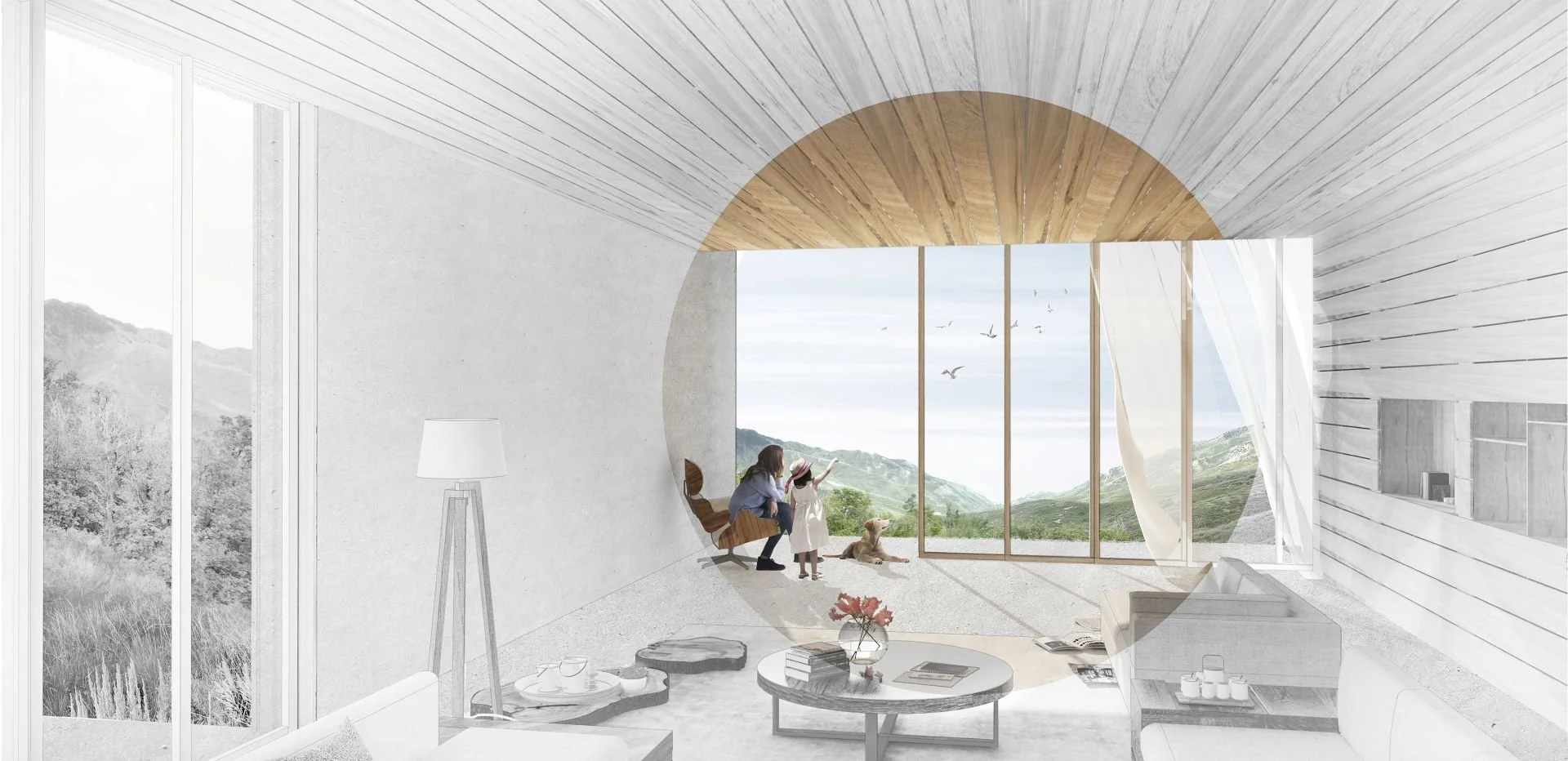
As contemporary architects in Salt Lake City and Los Angeles, Sparano + Mooney Architecture does not adhere to the values of idealistic beauty in design; rather, we seek to uphold the beauty of the subtle. We recently designed a house that embeds the idea wabi-sabi into the foundation of the residence. In conceiving the Wabi-Sabi House and while walking the site, the work began to coalesce around an idea of textures, materials, and expressed joinery and connections in the architecture. “It is interesting that there is not a term for this concept in the English language” says project architect Nate King. “The closest that we have is the idea of ‘rustic’. This home was based around this idea of accentuating the imperfect set against a backdrop of the refined, thereby allowing these contrasting notions to build on each other. The imperfect therefore appears to give more character and the refined appears even more polished”, he explains.
Located in Emigration Canyon above Salt Lake City, Utah, this 5,000 SF home celebrates a unique elevated canyon view with a direct connection to nature. Designed for a young family, this home is separated into two volumes that float above the landscape. The north volume is oriented along a direct east-to-west axis and includes the private domestic functions to address the quiet static mountain views to the north. The southwest volume includes the more public, active gathering spaces and is oriented along the canyon axis toward dramatic views to the city below.
Upon entry, the occupant is presented with a corridor and framed view of the mountains to the west. As one progresses through the space, the shift in program is presented with the architecture of the public volume aligned directly with the canyon view. The architecture includes a lower level that incorporates a creative office space with a private outdoor patio. This Utah home, designed to LEED specifications, includes a double wall system for maximum r-value and a vegetated roof, and is being constructed to include a roof-mounted solar PV array. The Wabi-Sabi House is expected to break ground in May 2017.

We hope to achieve a state of grace with this Utah residential design that does not shy away from natural processes, unpretentious irregularity, and heartfelt simplicity. As we continue to explore the nuances of wabi-sabi, and its potential to influence our design process, we welcome the opportunity to discuss how the concept might be applied to your next project. In the meantime, we will look to the cracks in the pavement for inspiration and reflect on how our own flaws make us each perfectly…imperfect.

PROJECT UPDATES
PROJECT UPDATES FROM SPARANO + MOONEY ARCHITECTURE
APRIL 24, 2017
2017 has thus far been busy for the Sparano + Mooney Architecture team and we are pleased to bring you a report on our progress! We remain committed to collaborating with our clients to produce great design, deliver thoughtful, innovative and contemporary design solutions, and position our exceptional people at dynamic centers of architecture. As architects working throughout the American West, Sparano + Mooney Architecture is dedicated to elevating a strong regional design movement and we welcome the opportunity to discuss your next civic, cultural, performing arts, master planning, worship, mixed-use, residential or commercial project. In the meantime, perhaps the updates below will help inspire!
RAWTOPIA RESTAURANT
The award-winning Salt Lake City restaurant, Rawtopia, is relocating to a larger space in the Olympus Hills Shopping Center where its flagship location will serve raw, vegetarian, vegan and organic fare. The restaurant selected our architectural team to create its new space which will double the restaurant’s previous capacity, as well as provide new kitchen space and equipment that will allow for menu expansion. In addition to fine dining, the restaurant design allows for a variety of food services, including a smoothie bar, patio dining and a to-go counter for those who love their Rawtopia on the run. The project is currently under construction and is scheduled to open early this summer.
UTAH STATE UNIVERSITY FINE ARTS COMPLEX
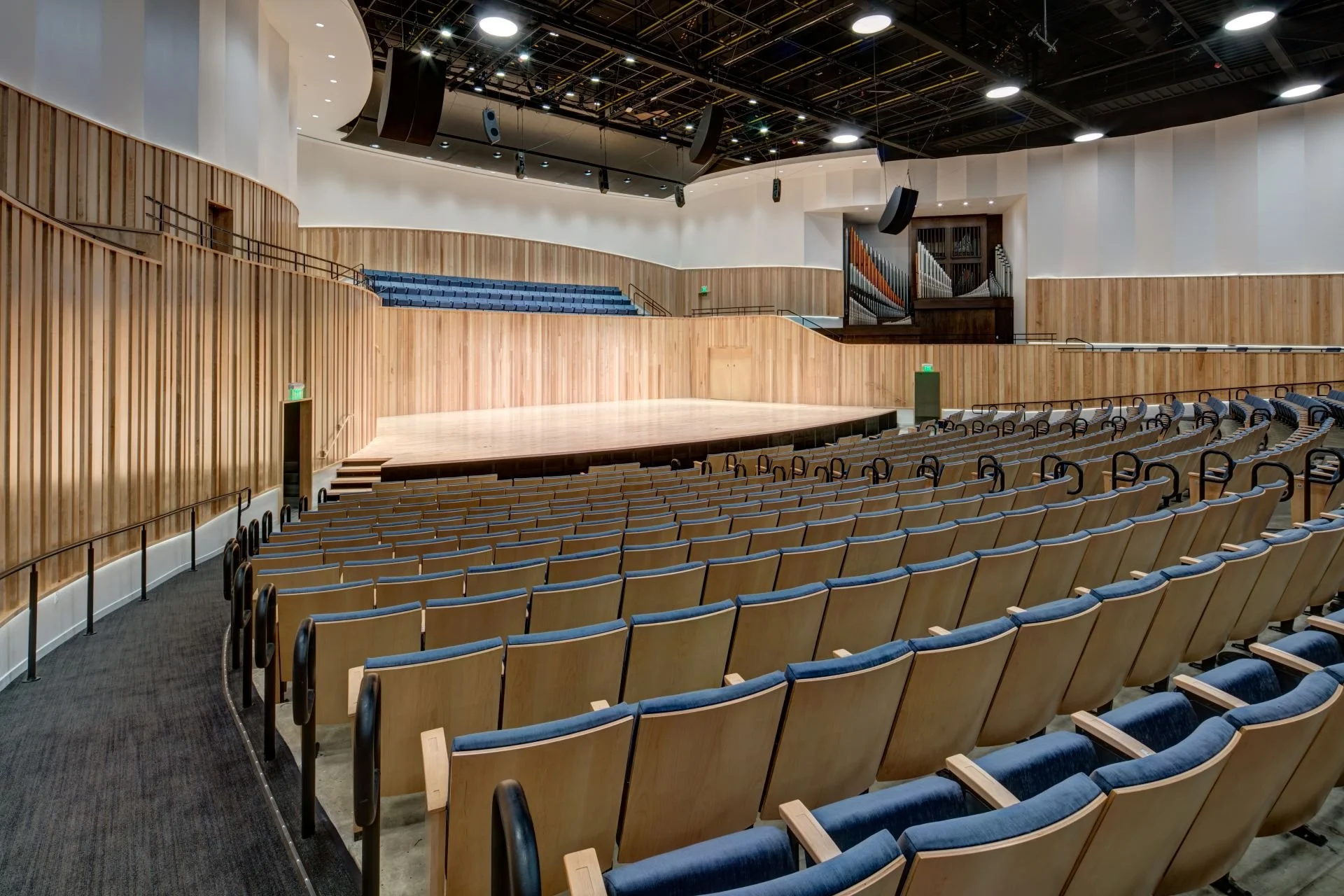
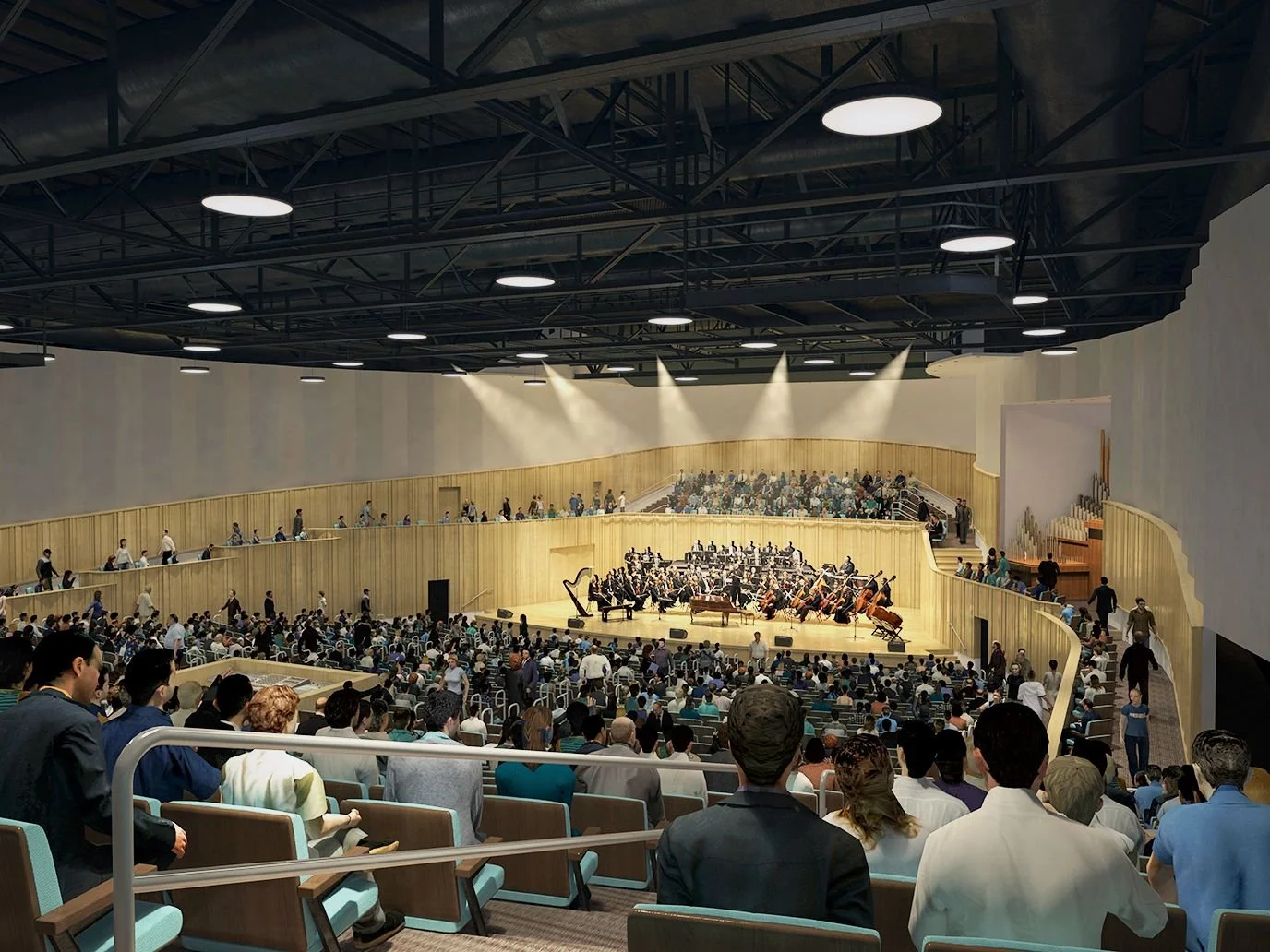
Utah State University’s Kent Concert Hall is undergoing a major renovation which will transform it from a multi-functional proscenium stage, to a state of the art choral and orchestral performance space. As part of the renovation, it will be renamed to the Newel G. and Jean C. Daines Concert Hall. The project is currently under construction, with theatrical and audio-visual systems being installed, tested and programmed. The first performance is scheduled for next fall, and the acoustics should be amazing!
The USU Fine Arts Center’s Scene Shop and Costume Shop were designed by Sparano + Mooney Architecture to increase the existing shops’ square footage to accommodate large sets and costume production, as well as modern, professional equipment to provide students a real-world theatrical experience. Both shops are now occupied by the user groups who are enjoying the new teaching and learning spaces and improved theater programming and production capabilities.
The Fine Art Complex Courtyard improvements include concrete and brick paving which has been installed, with landscape, lighting and irrigation in process. This landscape project should be wrapping in the coming months, and will provide a functional and beautifully designed focal point as a gathering space for students, faculty and visitors to the Fine Arts Complex.
RECREATION PROJECTS
Our Studio City Recreation Center and Gymnasium in Beeman Park will be Los Angeles’s first Net Zero Energy pilot project. The new 12,000 SF facility will be an immeasurable architectural asset to the neighborhood and community, and will also demonstrate the feasibility of designing self-sustaining, energy-efficient municipal buildings. The project is moving into the Design Development phase and we are excited to partner with the City of Los Angeles on this state-of-the-art, modern recreation facility.
The Pawley Pool Aquatic Facility, within the Desert Recreation District in Southern California, will serve the needs of the largest recreation district in the state. Among other amenities, the new pool and bathhouse will feature an activity swimming pool, lap lanes, new pool decks, meeting rooms, event spaces, parking and landscaping. The Design Development phase is complete, and we are awaiting the client’s comments before our architects will be moving onto Construction Documents.
Working with Landmark Design, we developed a series of design and planning options exploring the expansion and potential diversification of the amenities for the Deseret Peak Recreation complex in Tooele County. On 15 February 2017, the entire consultant team held a public open house at the Tooele County building and received community feedback. The team presented some fantastic opportunities to help user groups improve concert events, equestrian facilities and the county fair property. The feedback has been consolidated into a single document and next steps are currently being planned in coordination with the community toward a final master plan for the complex.
NEW RESIDENTIAL GROUND BREAKINGS
The Tree House project is located in the 9th and 9th neighborhood of Salt Lake City, Utah. This modern architecture urban house features a double height great room, a courtyard with a pool, and a secluded master suite. The project is currently under construction with anticipated completion at the end of the year.
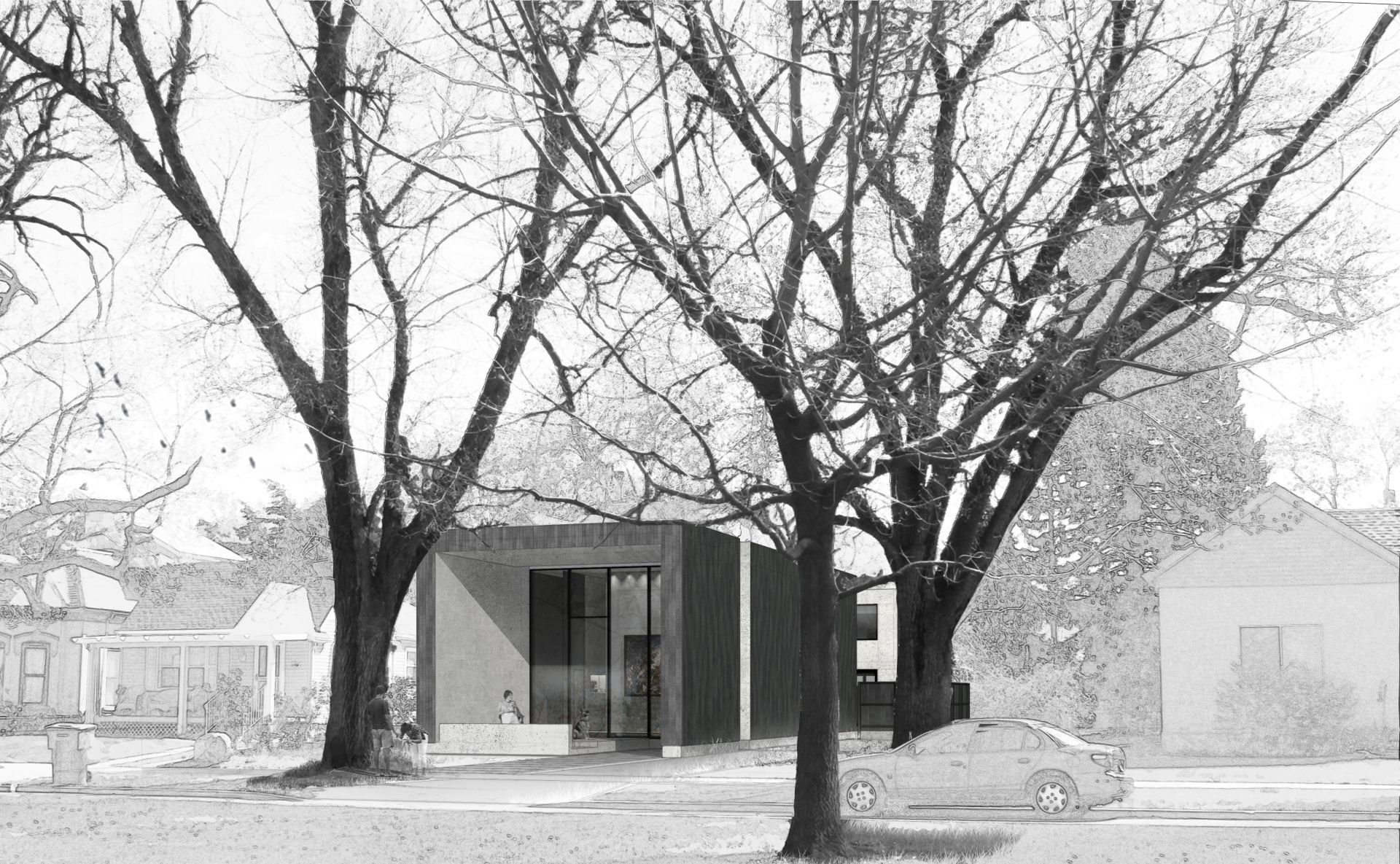
Located in Emigration Canyon above Salt Lake City, Utah, the Wabi-Sabi House project is a new home that is designed to celebrate a unique elevated canyon view with a direct connection to nature. We are happy to report that the permit has been picked up, the Limit of Disturbance fence is installed, and our LEED for homes planning is underway. Ground breaking is scheduled for May. The exterior of the home is a cedar rain screen cladding, and the materials for the interior include a contrast of pure white walls against a white oak wood flooring, cabinetry and hemlock ceilings.
BIG CARTEL CREATIVE WORKSPACE
You may recall reading our recent blog post about Big Cartel, our fantastic client and an incredibly cool webstore business provider dedicated to assisting creatives in reaching their potential. We have just finished a project to help Big Cartel design their company headquarters, and are honored to have helped bring the firm’s vision for their workspace to life. Located in the historic warehouse district in downtown Salt Lake City, Utah, the architectural design of this 3,200 SF tenant improvement was highly collaborative with the client and centered on creating a minimalist space celebrating the contrast between new and historic design elements. Simple detailing and consistent materials provide the setting for Big Cartel’s artist-based platform and graphic style.
Be sure to visit our blog in the coming months for in-depth articles about these projects, and the many others that are currently in the works, and please feel free to contact us if you have an idea you’d like our architects to help you turn into a reality!

GLOBAL / LOCAL / AUTHENTIC IN ARCHITECTURE
THE GLOBAL, THE LOCAL AND THE AUTHENTIC IN CONTEMPORARY ARCHITECTURE
APRIL 05, 2017
No matter which side of the aisle your views rest upon, it is generally agreed that the world is moving into uncharted socio-political and economic territory. As modern architects living and working in the American West, we can’t help but wonder how this new order will affect our industry: How will clients feel about the home of their dreams when their dreams may no longer reflect reality? Alternatively, will others feel bolstered by the changes that have occurred and want to invest further in their future on terra firma? What will happen to the cost of architecture, and the materials and labor of its construction? How will a shifting perception of the “local” versus the “global” influence the way our architects design and how our clients view contemporary architecture?
It seems others are asking similar questions. The 2017 Pritzker Prize (architecture’s equivalent of the Nobel) was awarded to a firm that, like Sparano + Mooney Architecture, is attempting to strike a delicate balance between maintaining a regional dialect and simultaneously conversing fluently in the international architectural dialogue. RCR Arquitectes, founded in 1988 by Rafael Aranda, Carme Pigem and Ramon Vilalta in Olot, Spain, is the 2017 Pritzker laureate. Hailed by the jury for an “approach that creates buildings and places that are both local and universal at the same time,” RCR is known for an adept handling of natural and industrial materials, and sensitive integration of their built environments into the surrounding landscapes. As the Pritzker jury noted, RCR have resisted “the call of the metropolis in favor of remaining closely connected to their roots”.
As the Los Angeles Times has reported, it is – if not explicitly stated – easy to implicitly read the jury’s decision as a comment on the ways that globalization, urbanization, the economic crisis and current political climate have derailed rural culture and the “authentic” in localized architecture. Indeed, the jury’s statement sharply underlines this viewpoint: “We live in a globalized world where we must rely on international influences, trade, discussion, transactions, etc. But more and more people fear that, because of this international influence, we will lost our local values, our local art, and our local customs.” There is anxiety here, the same trepidation that some architectural analysts have credited with giving rise to the political forces we’ve recently seen at play. The LA Times also indicates that while this fear is justified, temperance may be found in a new approach to the production and consumption of culture, and architecture might play an essential role in this new path. RCR’s tagline might say it best: the need for a “universe of shared creativity”, in which we are able to stand firmly rooted but welcoming to wider socio/economic/political/historical/cultural influences. Looking out, while honoring what’s within.
It is important to consider this language and what it might mean to us and our own “regional” approach, set within the inevitable, international backdrop of our industry. Our firm collectively and our architects individually draw inspiration from the context of the American West – the region’s unique history, landscape, materials, architecture and culture has deeply informed and inspired our work, which has been commissioned by clients in Utah, Wyoming, Montana, New Mexico, Colorado and California, as well as Africa and Haiti; our team has lived, worked, and studied in London, Switzerland, Spain, China, Italy and Germany, as well as the United States. Our architectural clients hail from diverse backgrounds. This polyglot has nevertheless led SMA to believe in the potential of the American West as a point of departure for world-class design, and we have consistently produced a body of work as architects dedicated to contributing to the elevation of a strong regional design movement.
The Topaz Museum, for instance, was designed by Sparano + Mooney Architecture to house the collections and present the experiences of the Japanese Americans detained at the nearby internment camp during WWII. It is tied directly to a remote locality, and yet it is inextricably linked to an ongoing debate about xenophobia and cultural identity. This relationship is complex. Is multicultural the new local? Can we entrust architecture to articulate our reservations about this new world? Perhaps it is not a matter of answering these questions definitively, but of the role of architecture to pose them in the first place.
FT. MOORE PIONEER MEMORIAL RESTORATION
A PHOENIX RISES IN LOS ANGELES: Architects Restore the Ft. Moore Pioneer Memorial
FEBRUARY 06, 2017
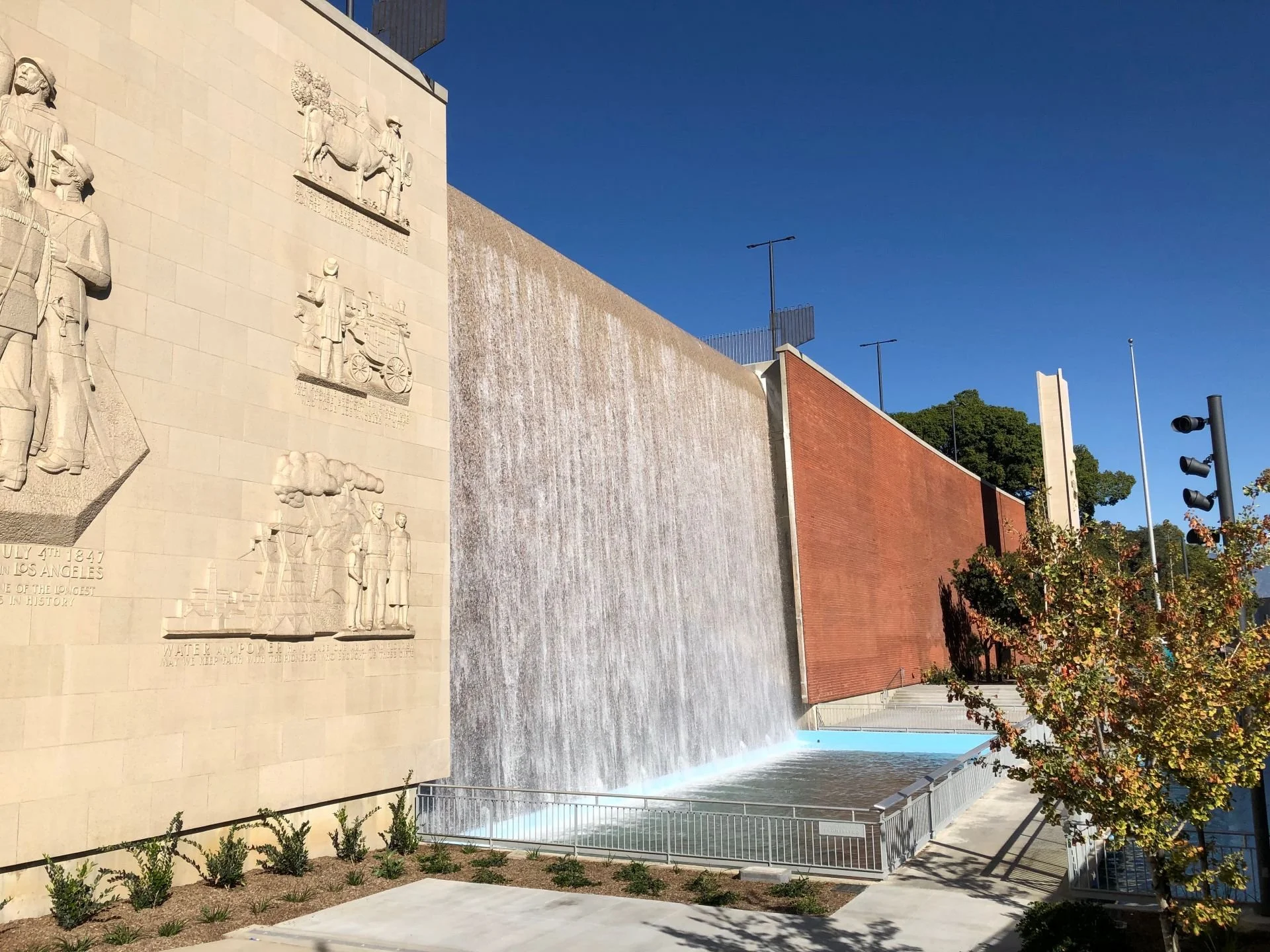
What do a London-born sculptor, Connecticut-based/German-native artist, the Mormon Battalion of Salt Lake City, Mormon Battalion of Council Bluffs, Iowa, and our firm of Los Angeles architects have in common? The answer might surprise you: the Ft. Moore Pioneer Memorial in Los Angeles, California. As reported on the front page of the Los Angeles Times on Saturday, January 28th, 2017, thanks to generous support from the Los Angeles County Board of Supervisors and with the technical and design team at Sparano + Mooney Architecture, the “forgotten memorial” is undergoing critical restoration to return the monument to its original civic glory.
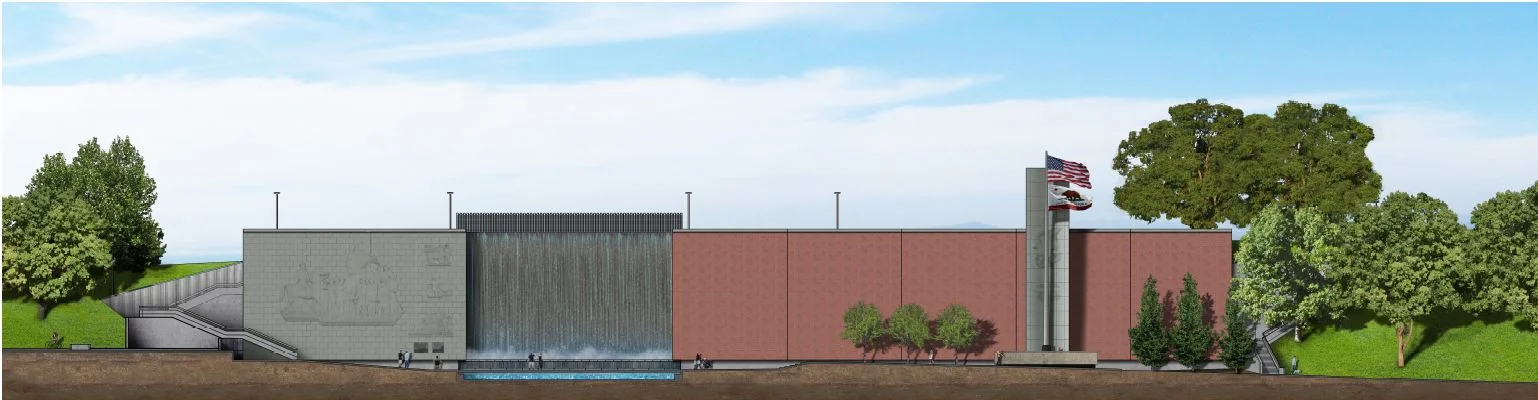
If you drive along the Hollywood Freeway, cross the Los Angeles River, pass Union Station, and look towards Chinatown, you may have noticed an enormous – if blighted – stone fortification of sculptural carvings, some 300,000 multi-colored mosaic tiles that once facilitated a dramatic 77-foot-wide waterfall, and a red brick wall, now blistered by worn graffiti and years of inattention. This is the current state of the memorial, which, after 40 years of neglect, will be resurrected after a serious effort to resuscitate this stirring tribute to military history, the enduring pioneer spirit, and California’s heritage. “It’s the most historically and geographically important monument that nobody knows about,” says Clare Haggarty, manager of L.A. County’s art collections.
The Ft. Moore Pioneer Memorial was dedicated on July 3rd, 1958, and celebrates the first raising of the U.S. flag over Los Angeles in 1847. At the dedication, members of the Mormon Battalion of Salt Lake City reenacted this historic event, originally performed by their forbearers, the Mormon Battalion from Council Bluffs, Iowa (joined by the 1st Regiment of Dragoons and the New York Volunteers) some 111 years earlier. These pioneering members of the U.S. military had marched some 2,000 miles to Los Angeles in preparation to protect the city from destruction in the Mexican-American war. The war had ended upon their arrival, but despite the ceasefire the Battalion stayed on long enough to hoist our nation’s emblem in commemoration of the first Fourth of July in Los Angeles. The event took place on the earthen walls of a fort the soldiers had built in order to defend the city during the conflict, named for Benjamin Moore, an officer who lost his life fighting in a battle near San Diego.
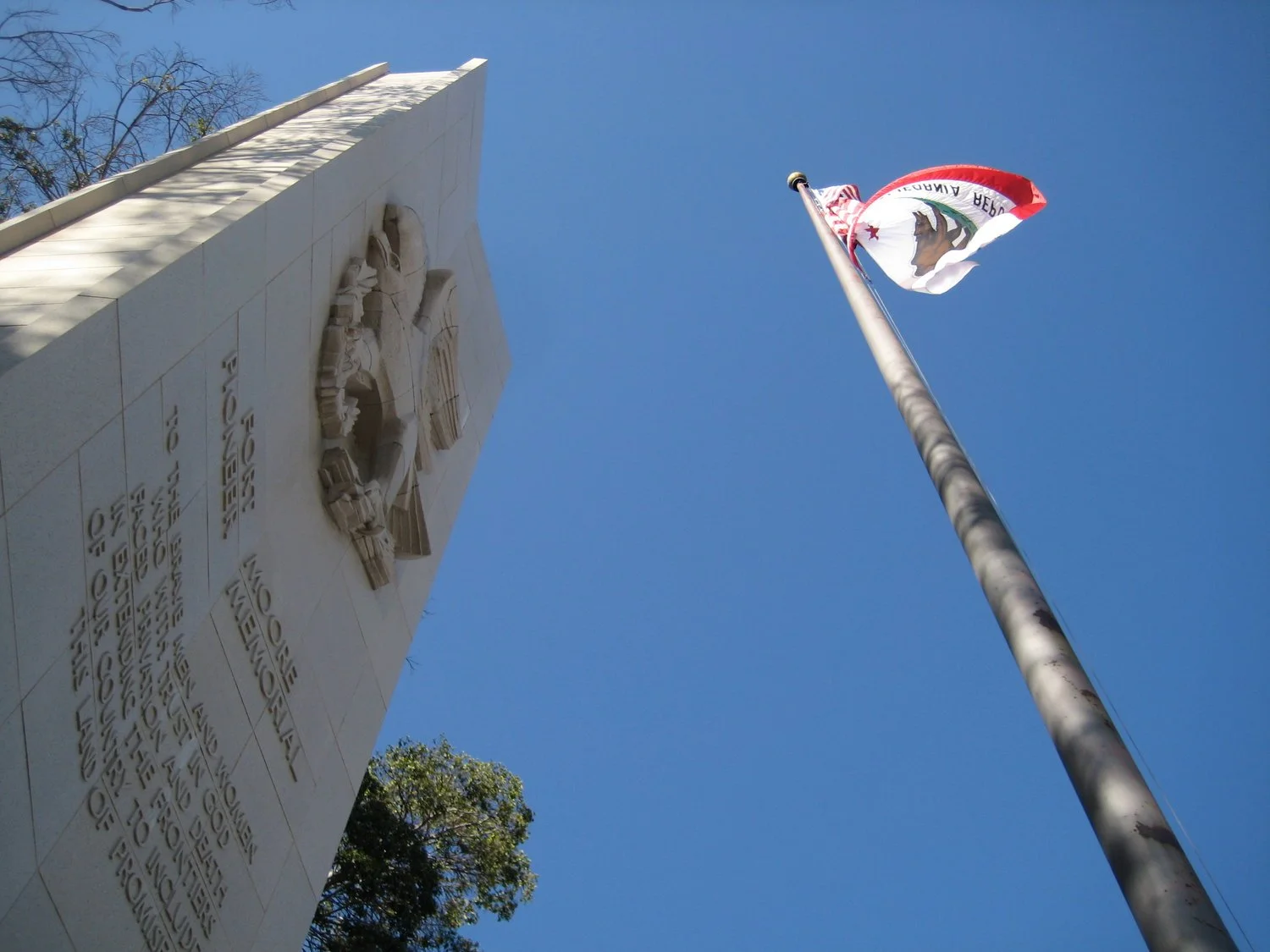
The creation of the Ft. Moore Pioneer Memorial resulted from the influence of the L.A. Society of the Daughters of Utah Pioneers, as well as the need for a large architectural wall to contain the earthen embankment known as Ft. Moore Hill, which remained after much of the original fort was leveled to make way for roads, buildings and a new Civic Center. The face of the hill was the design canvas for London-born artists Albert Stewart and Connecticut-based, German native Henry Kreis, immigrant sculptors who designed the bas-relief vignettes depicting the Mormon Battalion’s march and flag-raising, period transportation infrastructure, and regional scenes including cattle ranching and orange groves. The memorial also features a tableau recognizing the Los Angeles Department of Water and Power as a sponsor of the monument, and a 68-foot tall pylon bearing an eagle-adorned dedication inscription.
In 1977, the memorial’s centerpiece – an enormous cascading waterfall – was turned off due to drought conditions, and when water was once again plentiful, the waterfall was sadly beyond salvage. The mosaic tiles were crumbling, and the pumps had been vandalized. The red bricks became an urban canvas for graffiti, and the terra cotta tiles comprising the bas relief sculpture became worn and unkempt. The Ft. Moore Pioneer Memorial declined into obscurity, until an elaborate reenactment in 1997 reignited the community’s interest in the monument and its place in American history. After many years of effort, a plan for revitalization was approved in 2014, with funds committed from the Board of Supervisors and the City of Los Angeles. Sparano + Mooney Architecture is proud to be a part of this restoration, which will see the waterfall flow again (with a mindful balance between historical accuracy and water conservation), the tiles replaced, the bas-relief mural refurbished and the graffiti scoured away. A re-dedication is planned and we hope that when the date is announced, we will see you at the site of the Ft. Moore Pioneer Memorial, which will once again serve as a poignant reminder of our nation’s and Los Angeles’ architecture history and heritage.
SPOTLIGHT: JORGE BELTRAN
AN ARTIST AMONG US: The Sketches of Jorge Beltran
JANUARY 03, 2017
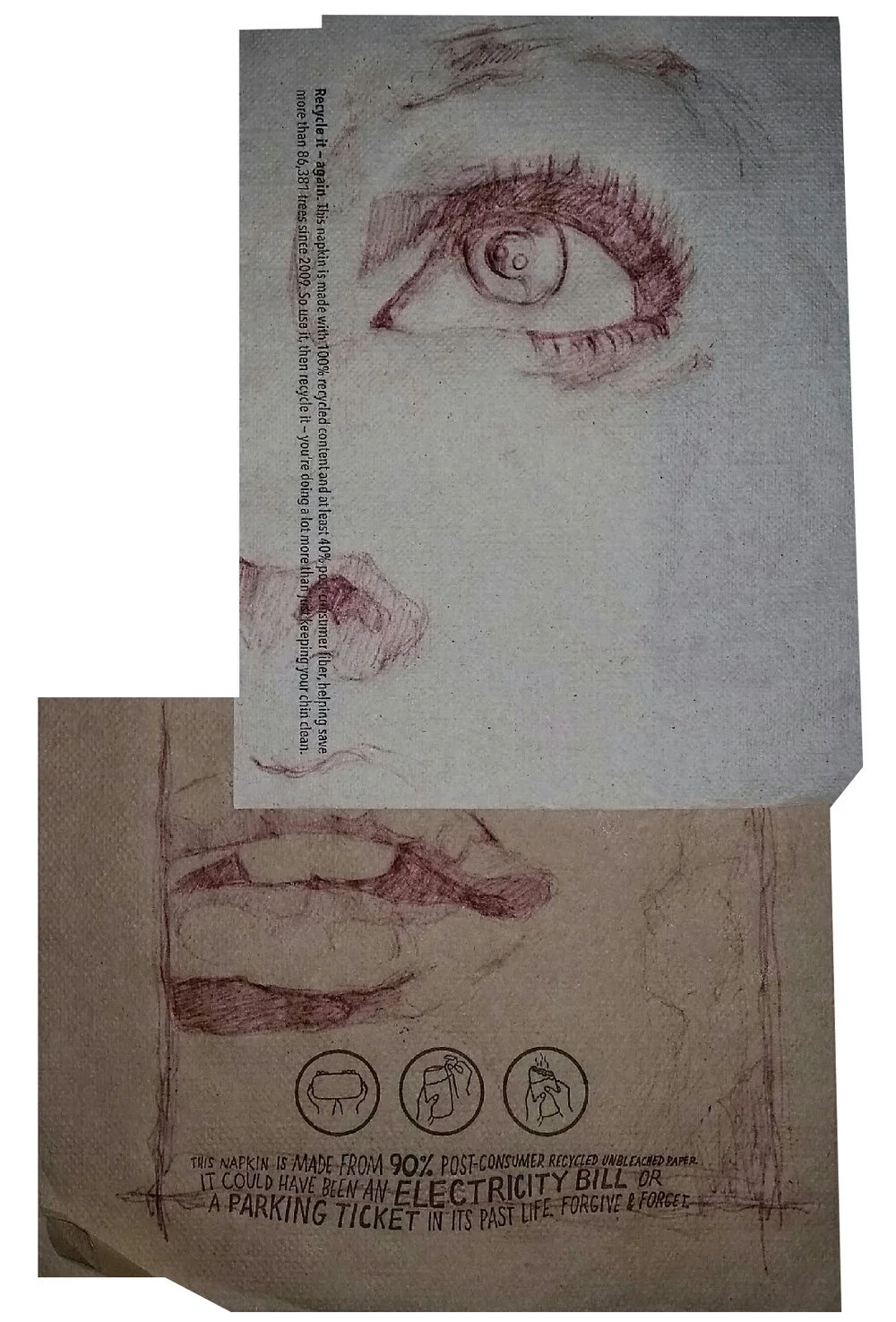
There’s no doubt about it – the Sparano + Mooney Architecture team are a talented bunch. We work hard to deliver thoughtful, innovative and contemporary design solutions; every day striving to produce beautiful architecture for our amazing clients. The interpretation of an idea from start to finish often involves numerous iterations of sketches, renders and plans. Putting pen, pencil and brush to paper is a key aspect of our practice and drawing skills are essential to the profession. But did you know that our team member Jorge Beltran, who recently celebrated eleven years with the firm, also produces phenomenal sketches at work and in his free time and is a supremely talented artist in his own right? We are blown away by Jorge’s talent, and interviewed him to discover more about his work.
When did you first begin to draw?
I started drawing in elementary school. The first notebook my mom bought me had Scooby-Doo on the cover. I tried to sketch it many times.
How did you learn to draw? Did anyone in particular teach or inspire you to draw?
I would always sketch on my own until I enrolled in our local community center to take the “Intro to Art” class. By this time I had been fascinated by the paintings that were inside our Bible. I always tried to sketch them – those paintings were my daily inspiration.
Do you still love drawing as much as when you first began?
I stopped drawing for a long time. The last “serious” drawing I made was way back in 2001. That was my “retirement” from art! After this, I only produced architecture-related work. Now that I recently started free-hand sketching again, it does feel the same as when I first began as a kid and I love it!
Why do you draw?
After all these years in architecture (I started college as an Art Major before I switched) I kept telling myself that I needed to start sketching again. Years passed by and maybe only a handful of (non-architectural) sketches made it to see the light of day. If I’m not drawing, I feel as if I am missing something – I need more than the click of the mouse every day!
What inspires you?
My family is my inspiration. They do what they love and they are great at it. I hope to think I do the same.
How does drawing influence how you practice architecture?
Sketching gives me a lot of freedom, it makes me see architecture with fresh eyes every time.
Have you ever exhibited your artwork?
Not in a gallery, but I was fortunate enough to have had some of my work exhibited. My art class work was promoted in the local TV news, and my piece was one of the few that was featured in the press. I entered art contests throughout my school years and was lucky enough to have those artworks exhibited.
What is your favorite subject matter?
As of now, my favorite subject matter is diverse and just something that catches my attention.
What is your favorite medium?
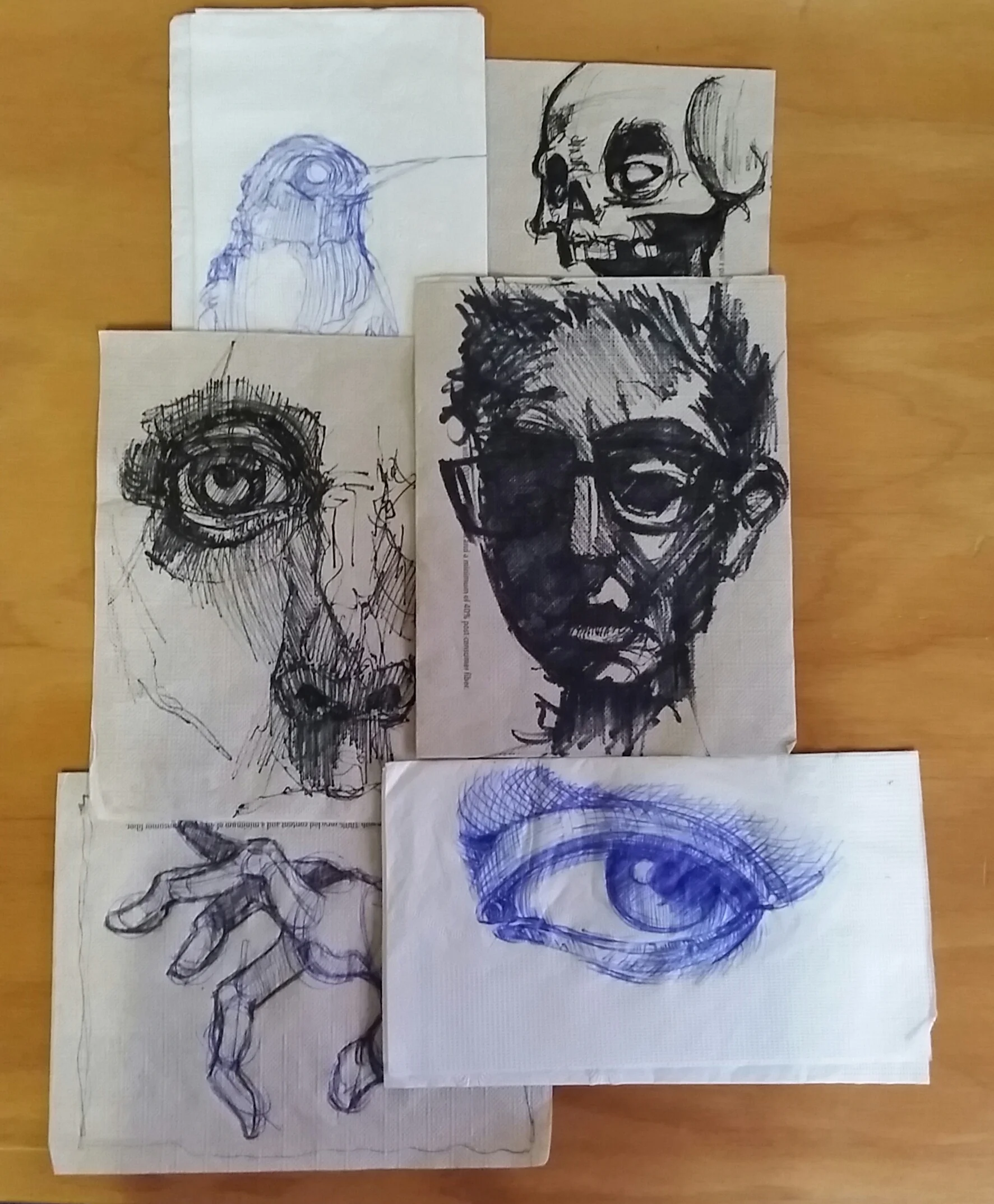
My favorite medium right now is pen and/or marker on napkins. I love napkins since they give me the freedom to not hesitate and just draw anything as loosely as I want. I sketch any artwork or images that catch my attention online.
Do you like talking about your artwork and talent?
I tend to keep it mostly private, especially since right now I am only sketching from images that I find online. I share a few sketches with my family and a group of friends BUT once someone asks me about it I can’t seem to stop talking about it! On that note, I hope my family doesn’t get tired and annoyed with me drawing their portraits!
When is your favorite time to draw, and do you have a favorite place to draw?
My favorite time(s) to draw is late at night and sometimes whenever I can during lunch at work.
How do you title or describe your work?
I don’t have any descriptions of any of the sketches since they are sketches of found images. If I find an image I like, I sketch it.
How do you hope your artwork will develop?
I hope I can make more time so I can draw more often. As it is, I only sketch once or twice a week at the most. Eventually if time permits, I would like to go back to where I left back in 2001 and with the practice/inspiration/exploration I get from the images I find online, I might get to where I’m doing my own drawings…one napkin at a time.
Watch this space – we have a feeling that Jorge's talents will continue to flourish! In the meantime we are so grateful to count Jorge as a longstanding member of our team and can't wait to see what he draws next...

SCIENCE, SUSTAINABILITY + SPIRITUALITY
SCIENCE, SUSTAINABILITY AND SPIRITUALITY JOIN FORCES IN ARCHITECTURE
NOVEMBER 15, 2016
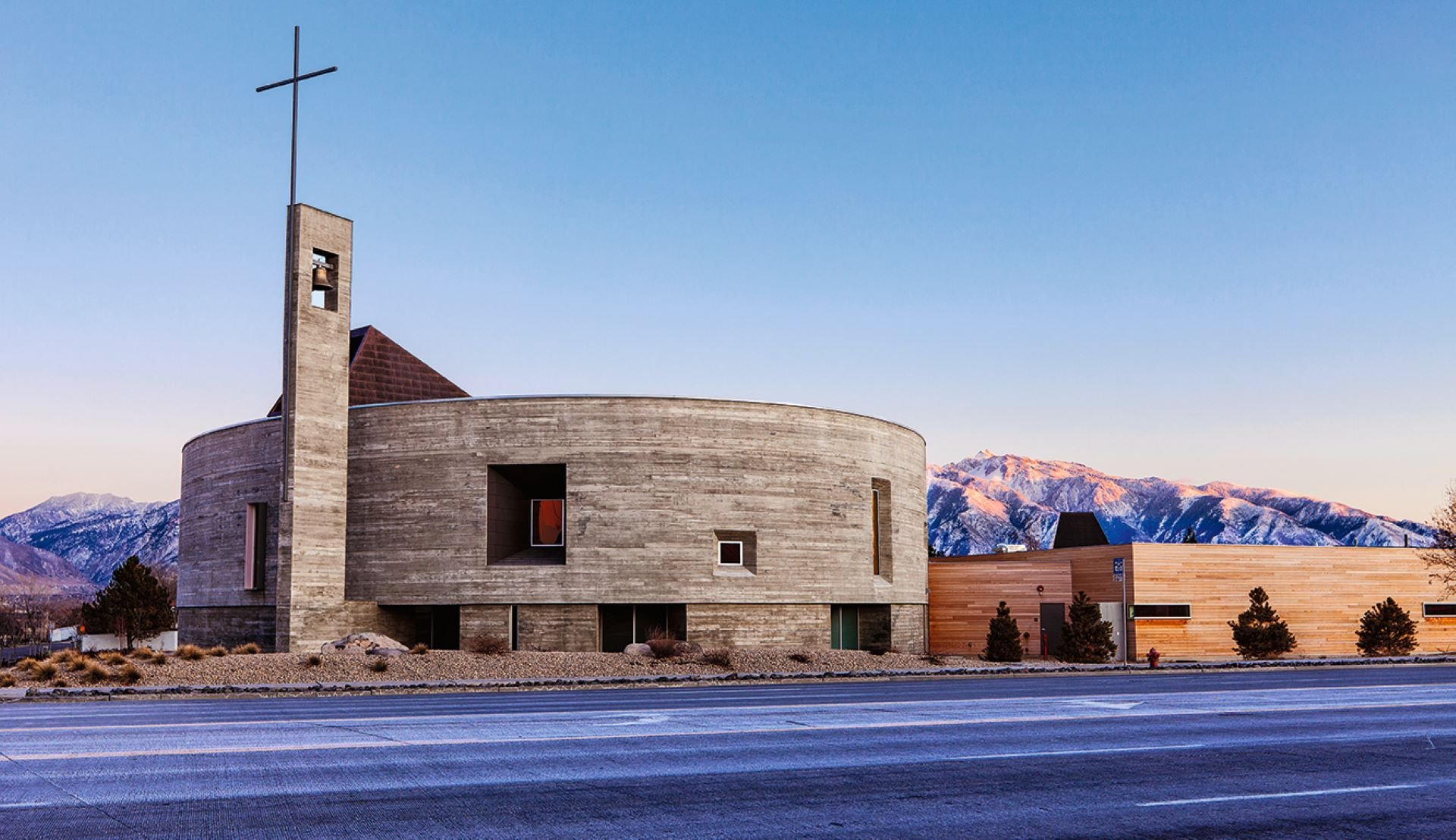
Green is good! At Sparano + Mooney Architecture, our architects value providing innovative, modern and sustainable design solutions for our clients. So, we were excited to read that two of our award-winning projects, the Saint Joseph the Worker Church and the Saint Marguerite School, have recently taken steps to continue their conservation efforts.
Sparano + Mooney Architecture was honored to provide community outreach, programming, master planning and design services for the Saint Joseph the Worker Church in West Jordan, which was built in 2011. When the worship project was completed, the design of the building allowed for a reduction in water consumption and xeriscaping was also implemented to help conserve resources. The solar array, installed in 2015, is the latest addition to the parish’s sustainable outlook. The church installed a bank of 55 solar panels to the building, which has cut the power bill by one third. Should more panels be necessary in the future, the required infrastructure is in place. The panels have given the church the ability to produce electricity, be more self-sustaining, help care for the environment and reduce its power bill. “Going green is kind of a big commitment”, says pastoral associate Jeremy Castellano, but the investment has paid off – since the solar panels were installed, the Saint Joseph the Worker Parish has eliminated 15 tons of carbon dioxide emissions and offset the equivalent of more than 2,000 gallons of gasoline and 4.5 million smartphone charges.
Saint Joseph the Worker Church and Saint Marguerite School each received grants through Rocky Mountain Power’s Blue Sky Renewable Energy program to cover a portion of the cost of adding the solar panels to the architecture. The program was initiated in 2006, and it has helped fund over 100 projects in Utah, Idaho and Wyoming. The church is working with Synergy Power, who helped facilitate and install the panels, to monitor how much electricity the panels produce, and to reveal other fascinating details about how the church is reducing its carbon footprint. The monitor is situated in the Gathering Space so that visitors can also keep track of the energy data. You can also view the real time data of the solar panel array – just click HERE!
A similar monitor is installed at Saint Marguerite School, also designed by Sparano + Mooney Architecture. The school, located in Tooele, is the third Diocese of Salt Lake City facility in three years to install solar panels (Saint Thomas More Parish was the first to install panels to its parish center in 2014, followed by Saint Joseph the Worker Church). Principal Lorena Needham says that the 32-kilowatt solar array and accompanying monitor allows the teachers to incorporate data from the panels into their curriculum across academic disciplines, adding that “it will enhance our ability to teach care of the environment because we can show by our actions what it is we’re teaching”.
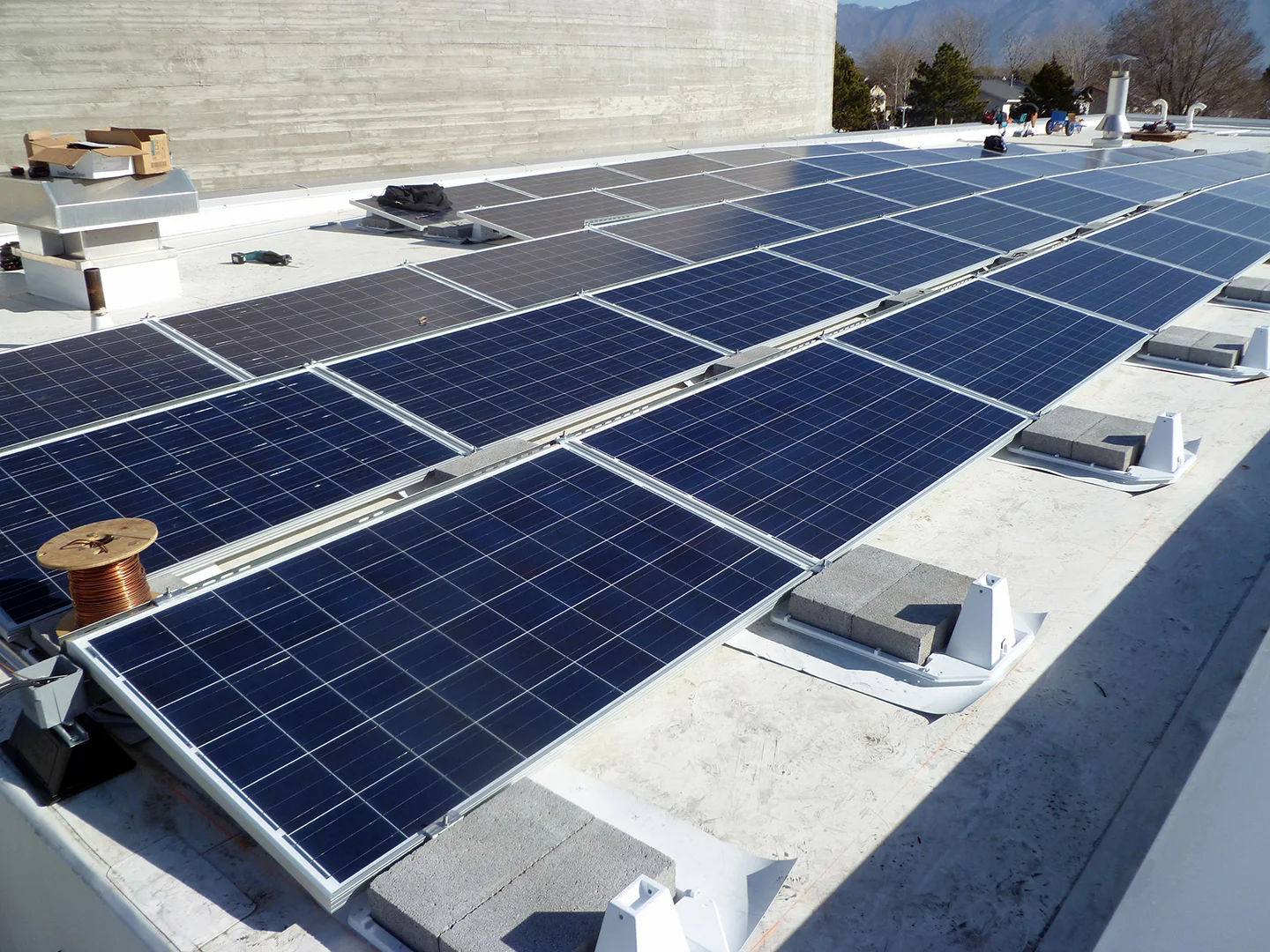
Photo courtesy Saint Joseph the Worker Catholic Church. © Saint Joseph the Worker Catholic Church
The solar panel arrays on Saint Joseph the Worker Church and Saint Marguerite School are not yet large enough to power the entire facility, but the savings are measurable and significant nonetheless. However, as Castellano states, “it’s not only about saving money, which is of course important when you’re running a church on donations, but the real big pro is helping save the environment, and that’s part of what we look at is being Catholic here: protecting the environment and God’s creation, and this is our way of making a small, little difference in our little corner of the world”. Amen to that!
Thinking about starting an eco-friendly architectural project of your own? As experts in sustainability in architecture, we can provide you with sustainable design guidelines and audits, sustainable project planning, passive design and LEED consulting services, net zero projects and LEED certified architecture. Give us a call – our architects will be happy to talk to you about your next green design project in California, Utah and beyond!

DESIGN WEEK
IT’S HERE AND IT’S HAPPENING! DESIGN WEEK, OCTOBER 17-22
OCTOBER 20, 2016

That’s right – Salt Lake Design Week is officially underway, and we are beyond excited to be a part of this city-wide cultural extravaganza! As Salt Lake City architects deeply committed to producing and inspiring great design, we can’t wait to sample the artistic cornucopia that this creative-minded city has to offer this week. So get ready to sharpen your creative edge and join us for what is shaping up to be a stellar event…
The intent of Salt Lake Design Week is to raise awareness of the impact that all design, including architecture, advertising, photography, fashion, product, interior and graphic, has on Utah, its residents and visitors. Salt Lake Design Week assembles professionals, students, entrepreneurs, architects, educators and broader members of the community to herald design in our fantastic metropolis. Impressively, since its inception five years ago, Salt Lake Design Week has engaged over 50,000 people and continues to motivate critical thinking in even the youngest of participants. Sparano + Mooney Architecture has participated almost every year with open studio tours, architect talks, exhibitions, installations and design award celebrations. Some of you may remember the fashion show runway installation architect Anne Mooney helped coordinate for her University of Utah architecture students during Design Week 2013.
This year a series of events – workshops, lectures, business development sessions, film screenings, studio tours and exhibitions to name a few – will encourage collaboration and inspiration among Salt Lake’s numerous design groups, museums, architects, businesses and educational and cultural institutions. Through these offerings, Salt Lake Design Week seeks to provide forums for professionals and the general public alike to interact and learn from each other, and in doing so, initiate a stronger creative community. How cool is that?!
A cross-section of events include: “Designing Gender: The Art of Equality”, a conversation about the intersection of marketing, design and social science, and how advertising can affect the realities of the people it influences (held at Studio Elevn); “Monsters + Mayhem”, a judged mini-monster movie competition with keynote speech and critique, hosted by OctoLeague and the Salt Lake Film Society (held at the Tower Theatre); “Morph 3D”, an exploration of consumer virtual reality and shared digital consciousness (held at the Utah Museum of Contemporary Art); and the Bizarre Bazaar closing party, a so-called “psychedelic sideshow and soiree” (held at Shades of Pale Brewing Tap Room). In addition, several studio tours form an integral component of Salt Lake Design Week. Tour stops include Contravent, Jibe Media, Dinng, Super Top Secret, Struck, Modern8 and Brute Squad. These personal and private tours offer eye-opening insight into the creative processes honed by some of the city’s most notable design firms, and we have enjoyed being featured as top Salt Lake architects in past events and studio tours.
As part of Salt Lake Design Week, be sure to check out the DesignArts ’16 Exhibition at the Rio Gallery. The exhibition closing reception and celebration will take place Friday, October 21st from 6-9pm. Award-winning work by Sparano + Mooney Architecture is on display and we hope to see you there! If we don’t have the chance to meet during Salt Lake Design Week, we’d love the opportunity to discuss our design philosophy and to create a unique work of architecture for your next civic, municipal, institutional or residential project in the American West!
Salt Lake Design Week is hosted by the Salt Lake City chapter of AIGA, the Professional Association for Design. For more information, and to purchase tickets to selected events, please visit the Salt Lake Design Week website. Design matters!
PULSAR HOUSE PROJECT AWARD
A STAR IS BORN: Pulsar House Project Wins 2016 Design Arts Utah Award
OCTOBER 11, 2016
Sparano + Mooney Architecture is delighted to announce that our Pulsar House Project has been recognized with a 2016 DesignArts Utah Award! The Utah Division of Arts + Museums DesignArts Program is dedicated to the promotion of excellence in the diverse fields of architecture, graphic and industrial design in Utah. They strive to help the citizens of Utah see, experience, use and value the art of design that surrounds us daily – we are honored that our architects were chosen as a recipient of this year’s award!
Creating a design for a client’s new home is always a great opportunity for an architect. For this house, an investigation into pulsars (short for pulsating radio star) formed the conceptual foundation of this residential architecture project. Pulsars are highly magnetized, rotating neutron stars that emit a beam of electromagnetic radiation. Observations of a pulsar in a binary neutron star system were used to indirectly confirm the existence of gravitational radiation. This residential project was designed for a pilot who envisioned an ultra-modern house on earth, connected to the stars.
Our team analyzed the activity of two particular pulsars, the Crab Nebula (catalogue designations M1, NGC 1952, Taurus A) and Vela Pulsar (PSR J0835-4510 or PSR B0833-45) on the date of August 16th, 2010, a day that the client wished to commemorate through the architecture of his mountain home. The forms were generated to highlight the physical relationships between each pulsar trail and the mountain site located in a canyon between Salt Lake City and Park City, Utah.
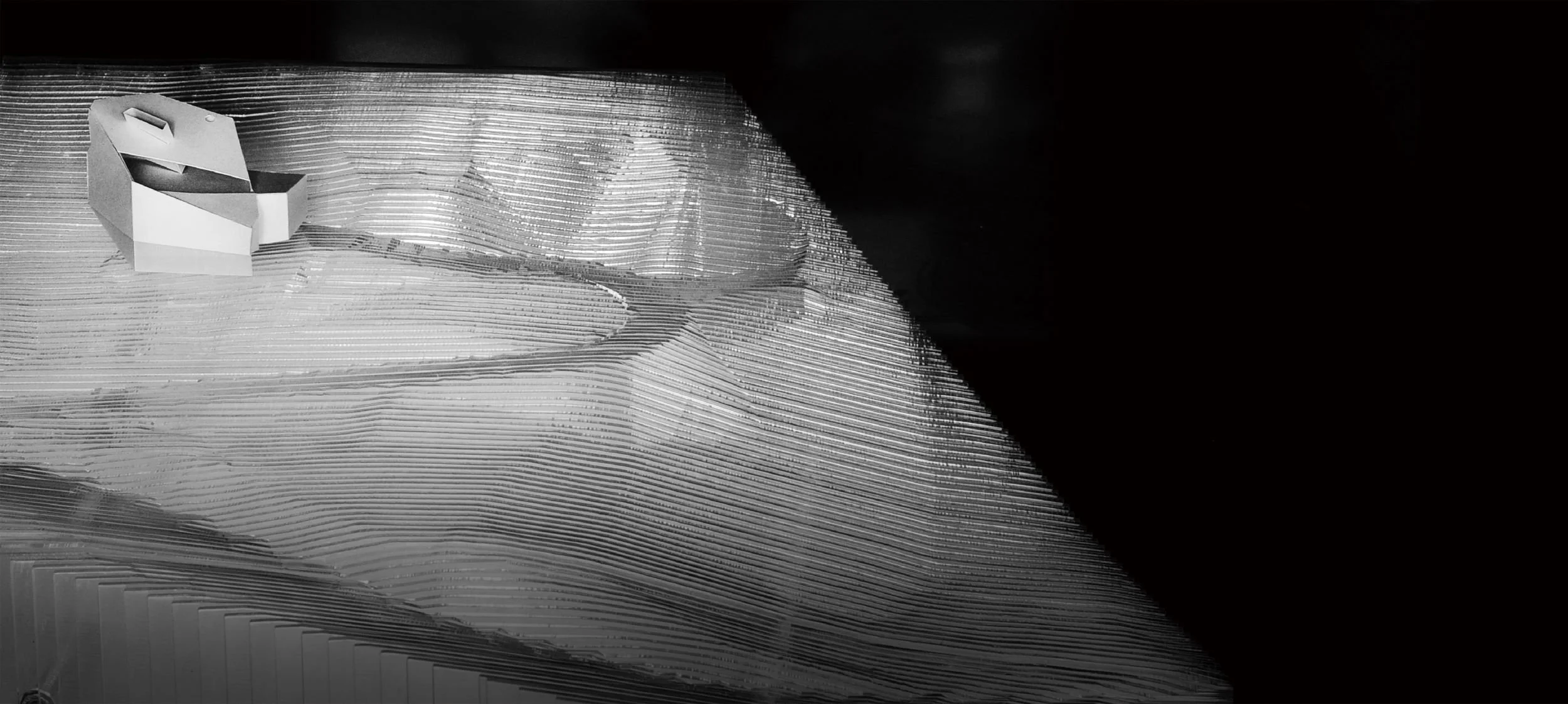
In a series of physical study models for the architecture, each pulsar trail is represented as the centerline of the negative space, the magnitude of the pulsar defines the lofting boundary of the centerline, and the geological location of the site is shown as the original 4” x 4” x 4” volume. At the same time our architects developed digital models – full scale in the computer – to study the form and precisely model the spaces and interior experience. In the programming studies for the house, the pulsar trail acts as a timeline moving through each scene of the client’s daily activities. These events are all connected accurately in the architectural plan and the cross sections with the pulsar location at a specific moment. The final massing is a combination of TIME (programming study) and SPACE (formal study).
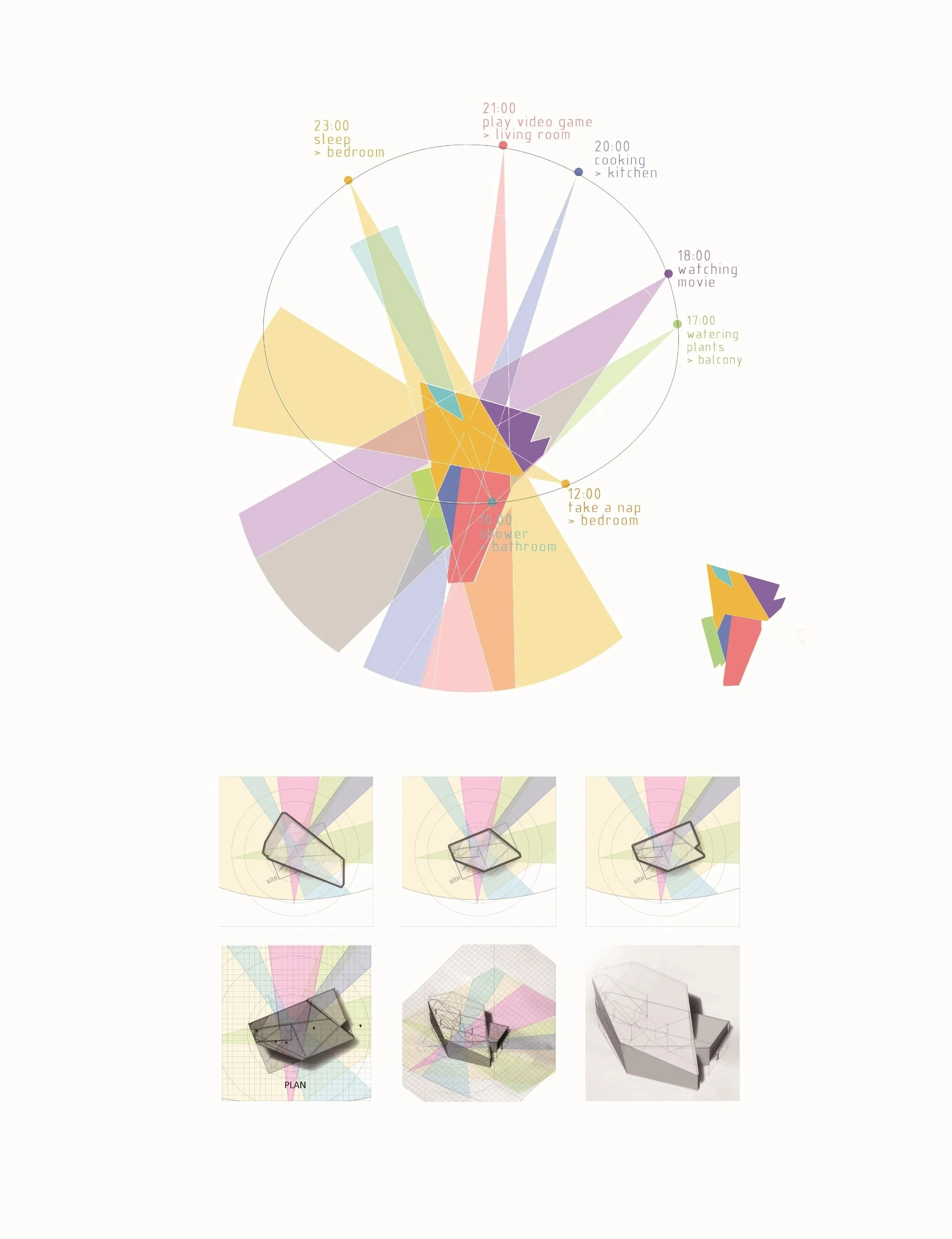
The architectural design process incorporated this body of research with broader investigations of the solar system, and generated residential architecture that is simultaneously site specific and universally grounded. In responding to the mountain site, we positioned the form of the house straddling the ridgeline, engaged with the slope at the high end of the site and floating above the land as it falls away, and the linear windows on the façades are meticulously designed to create a dramatic projection effect provided by natural sunlight, which changes continuously according to the time of day and seasons. We selected metal as the façade finish, which has a patina of age, sustainability, recycling and adaptive re-use. This material is also an ideal architectural response to the local climate in Utah.
The architects at Sparano + Mooney are over the moon with the award, and we invite you learn more about the project by visiting an exhibition showcasing this design and all of the other 2016 DesignArts Award winners. The DesignArts Utah ’16 Exhibition will be held September 9th – October 21st, 2016 in the Rio Gallery at the historic Rio Grande Train Station in downtown Salt Lake City. The exhibition closing reception and celebration is October 21st, 2016 from 6-9pm and will coincide with Salt Lake Design Week and Salt Lake Gallery Stroll at the Rio Gallery. Then let us know if you are ready for our architects to design a one-of-a-kind work of architecture for your residential project in Park City, Salt Lake City or Los Angeles!
PUBLICATION: UTAH STYLE + DESIGN, PARK CITY MODERN
PARK CITY ARCHITECTURE DESIGNED BY SPARANO + MOONEY ARCHITECTURE IS FEATURED ON THE COVER OF UTAH STYLE + DESIGN, SUMMER 2016
SEPTEMBER 19, 2016
If you are looking for a pleasant way to pass time indoors as the seasons change, look no further than the Summer 2016 issue of Utah Style + Design - a Park City modern home designed by Sparano + Mooney Architecture has been featured on the cover!
The corresponding article, “Opening Act”, written by Natalie Taylor and photographed by Scot Zimmerman, showcases the “strikingly beautiful” contemporary residence, which “combines dynamic architecture with high-style livability and sustainability”. The clients were clear about choosing the right Park City architect and about their must-haves: “We wanted a relatively quiet house with no duplicate spaces. It was critical that the house feels like it belongs on the land and that it fits peacefully into its environment without feeling forced”.
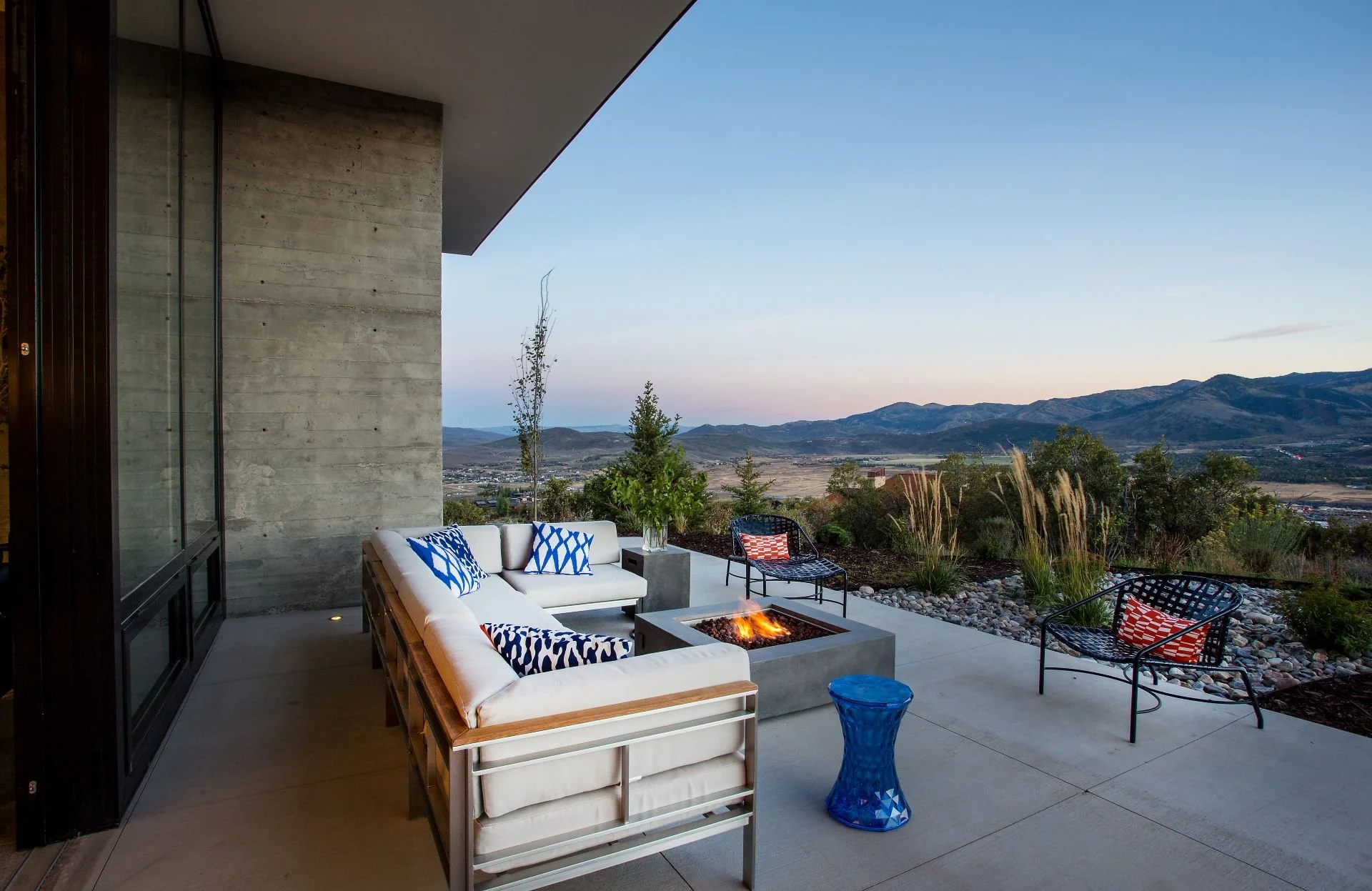
Located in a mountain setting with views of Park City Mountain Resort, the Utah Winter Olympic Park and the Glenwild Golf Course, the architecture and design approach to this mountain modern home sought to embed the architecture into its site. Exterior materials are both rough and refined: a highly textured board-formed concrete wall is capped with smooth wood panels and glazed surfaces above. These materials reference the highly textured scrub oak prevalent at the site under an expansive western sky. The vegetated rooftop incorporates native plant materials and will mirror the surrounding landscape each season: from the snow in winter to green in the spring to muted brown and yellow tones of late summer.
The house celebrates Utah’s brilliant light and raw beauty as nature provided the architectural inspiration. As architect Anne Mooney explains in the article, “Utah has incredible environmental scale and you want spaces that refer to the mountains, the sky and the horizon. But in a home, you want more personal, human scaled spaces”. The siting therefore maximizes its passive solar orientation bringing light deep into the house in the winter and shading the living spaces through well-considered overhangs in the summer. Outdoor living spaces are integrated adjacent to the master suite and great room and a rooftop deck that overlooks a nearby golf course. The green Park City home, has been certified LEED Gold, and incorporates renewable energy with a ground-source heat pump and high performance, energy efficient building systems.
Sparano + Mooney Architecture is delighted to have been able to work with the client to deliver a beautiful, livable mountain modern home and to have contributed positively to the Utah architectural landscape. And, we are honored to have been featured in Utah Style + Design, which continually showcases the best of Utah and the mountain west’s design, architecture and dining, as well as entertaining ideas for living the good life at home. The magazine features unique and beautiful interiors, decorative treatments, lush landscapes, inspiring entertaining ideas and provocative residential and commercial architecture. Published with the discerning homeowner in mind, this award-winning magazine provides its readers with innovative ideas and interesting stories, insightful writing and lavish full-color photography, sharing the best of Utah style throughout the state and beyond. A big thank you to the magazine for including us and our work as architects serving Park City in this category!
Photomural Project
COMMONWEALTH: Photomural Project Features Sparano + Mooney Team
AUGUST 01, 2016
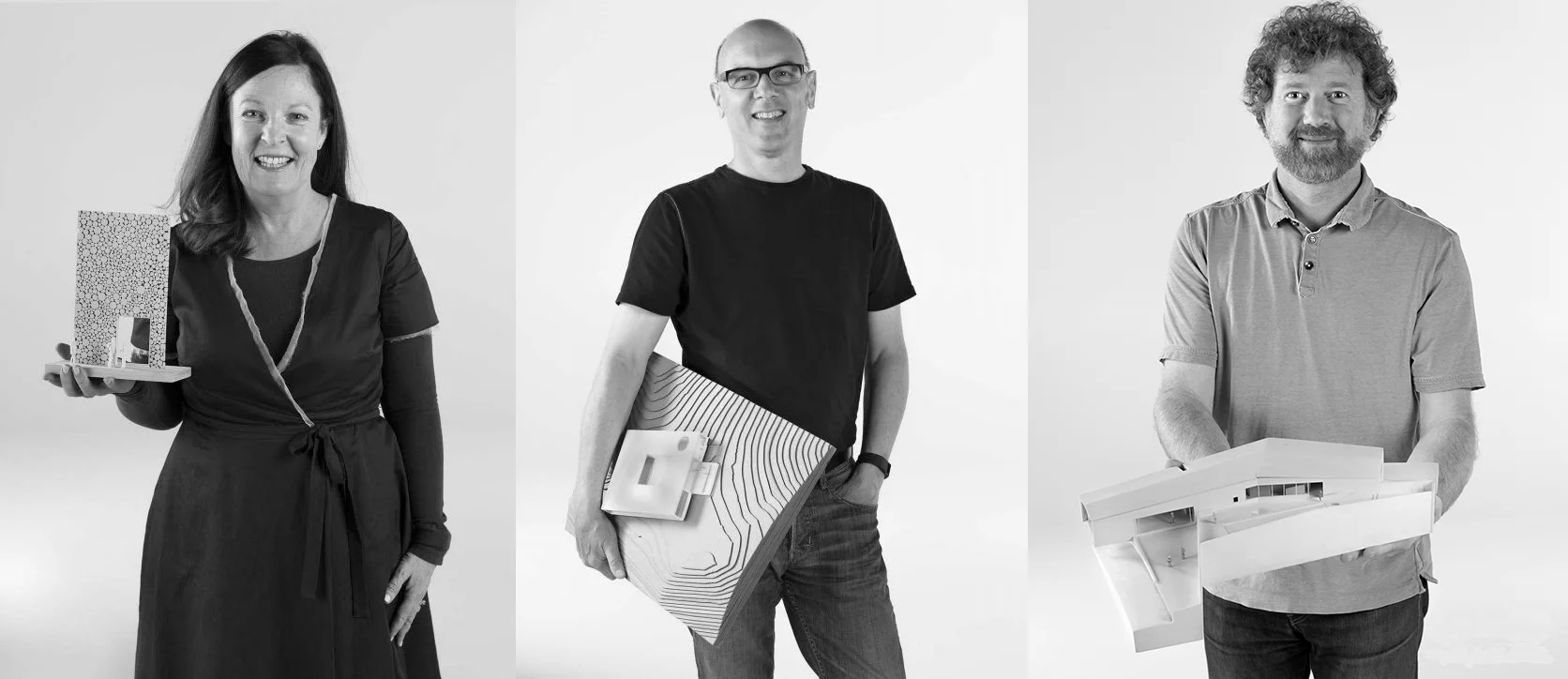
No, you’re not seeing double and yes, our team member architects Anne Mooney, John Sparano and Seth Striefel are indeed larger than life! At least, in the Arts Council’s photomural public art project, where oversize photographs of the architects, along with 50 additional creatives and artisans who live and work in the community, have been affixed to the exterior of local businesses.
In planning the new Downtown, the City wanted to highlight the revitalized arts district and showcase the area’s unique talent. “We have been blown away by the creative talent and innovative thinkers already here”, said Arts Council Coordinator Lesly Allen. “Sparano + Mooney Architecture is a key element to what we want our downtown to be”. Lesly also noted this architectural firm’s ability to take gritty, industrial-feeling spaces and create welcoming environments in which you’d want to spend time.
The mural project, a creative place-making initiative and community identity program, was inspired by the East High School project titled Inside Out, which involved photography being posted on building exteriors to bring awareness to wider social justice conversations. Like the Inside Out project, the Commonwealth: Inside South Salt Lake photomurals are made from a unique material: wheat paste. This non-toxic solution is easily removed with power washing and is designed not to impact masonry facades or walls. In fact, Sparano + Mooney Architecture was proud to offer the east wall of its building to the exhibition – our wall featured images of other Utah creative professionals Aruna (a Bookworm), Clyde (a Guitarist) and Casey (a Photographer).
The photographs of Anne and John were located on the south facade of Shades of Pale Brewing, and the image of Seth was located on the exterior of The Tree Broker. It was a wonderful project and we were thrilled to help support the fantastic work being done by our local Arts Council.
Photo Credit: Lars Call
Spotlight: Jun Li
JUN LI PRESENTS HER VISION OF A STANDARD ARCHITCTURE IN A NOT-STANDARD WORLD
JULY 25, 2016
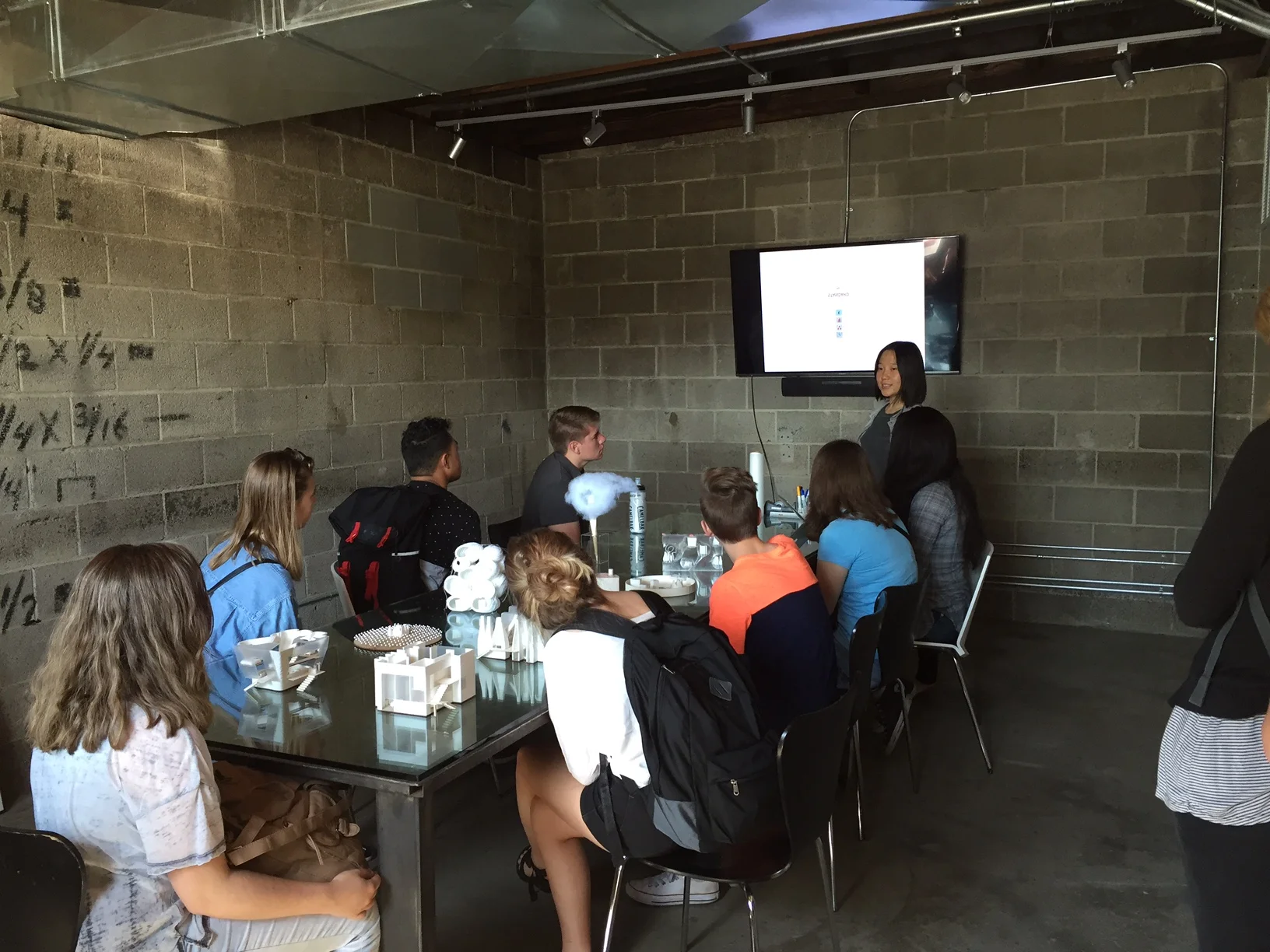
“Forget about the Boring World! Welcome to our Not Standard World!” So begins Jun Li’s presentation titled Not Standard, which she delivered recently to the next generation of architects visiting from an immersive summer design program. Jun, an architectural intern at Sparano + Mooney Architecture, asked the students to consider: How do we design for a diverse public experience in an increasingly standardized world? Though it may be tempting to conceive of and produce generic spaces, Jun posits that you can design for individuality and the creation of a unique product, perhaps paradoxically, through a standardized data-gathering process. First, we must take into account the variability of a client and the fluid environment in which they wish to live or work. But, by asking broadly applicable questions to distinguish differences such as gender, age and body type, and subjective preferences like whether one prefers to live alone or among others, Jun proposes an evolution of architecture that is intimate and better suited to clients’ personal needs.
Jun Li was born in Taiyuan, China, and studied Environmental Art Design at one of China’s leading architectural institutions, Jiangnan University, where she specialized in construction, structural and design research related disciplines. She then earned her Master of Architecture from the University of California, Berkeley where she focused on architectural design, landscape design and material research in her graduate study. Jun’s work was selected for UC Berkeley College of Environmental Design’s Annual Project publication and she received the award for Outstanding Undergraduate Thesis at Jiangnan University.
Jun is a wonderful member of the Sparano + Mooney team and we are pleased that she was able to help shape the future of these young and aspiring architects!
Los Angeles' First Net-Zero Gymnasium
NEW PROJECT BY SPARANO + MOONEY ARCHITECTURE WILL FEATURE THE CITY OF LOS ANGELES’ FIRST NET-ZERO GYMNAISUM
JULY 18, 2016
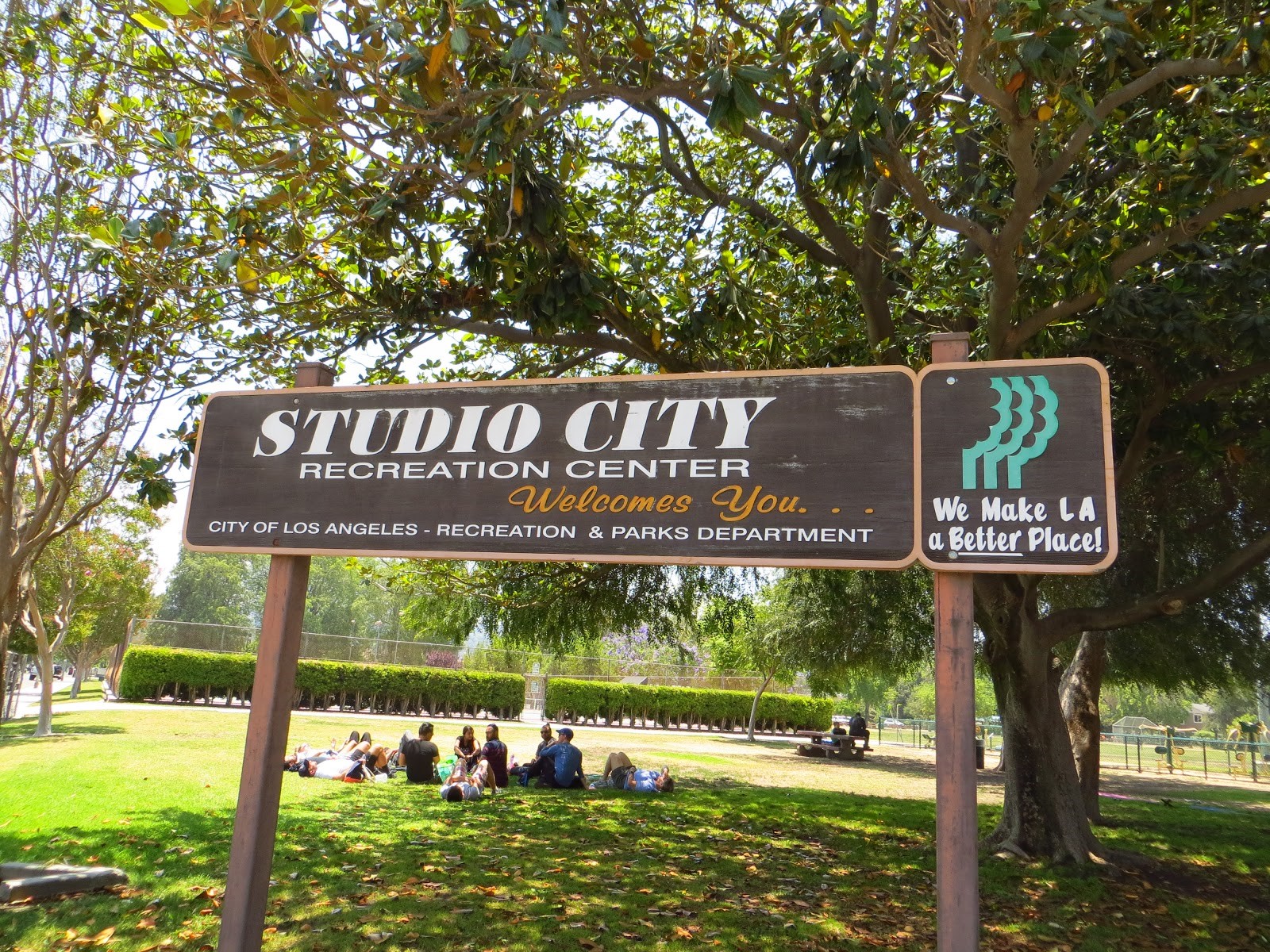
The Studio City Recreation Center Gymnasium in Beeman Park, located in Studio City, California will be Los Angeles’s first Net-Zero Energy pilot project. Designed by Sparano + Mooney Architecture to LEED-certified specifications, the new 12,000 SF facility will be an immeasurable asset to the neighborhood and community, and will also demonstrate the feasibility of designing self-sustaining energy efficient municipal buildings. The project scope replaces an inefficient recreation building with the construction of new, state of the art modern architecture. The recreation center will include a full-size basketball court, multipurpose meeting rooms for the community, office and administration areas, a kitchen, restrooms and support facilities. The project scope also includes security lighting, a parking area, new landscaping and irrigation for the park. With a projected total construction cost of $7M, the gymnasium will be ready for public use and exceed of code requirements for Net-Zero Energy.
NET ZERO ENERGY BUILDING - WHAT DOES IT MEAN?
A net-zero building exhibits zero net energy consumption – the total amount of energy that the building uses annually is generally equal to the amount of renewable energy created on the site. The architecture cleverly balances the energy it needs with the energy it produces from renewable, zero-emissions sources. The architects, engineers and builders work together in designing and constructing to these environmental standards which offers significant operational and maintenance costs savings, lower environmental impact, long-term improvements in energy efficiency, and better resiliency to power outages and natural disasters. Several Federal executive orders and legislation, as well as State and local initiatives and industry programs, have established Net Zero Energy targets. The U.S. Department of Energy has released a full report on net-zero energy buildings, and more information can also be found through the Sustainable Facilities Tool, as part of the Office of Federal High-Performance Green Buildings.
Another program we follow is the Living Building Challenge, an international sustainable building certification program created for architects and others involving in the built environment to guide sustainable development. This program is administered by the non-profit International Living Future Institute. It is described by the Institute as “a philosophy, advocacy tool and certification program that promotes the most advanced measurement of sustainability in the built environment.” The Living Building design principals can be applied to architectural projects of all scales, from buildings – both new construction and renovation projects - to infrastructure, landscapes, neighborhoods and planning communities. The Living Building Challenge is even more sustainably rigorous than the United States Green Building’s LEED program.
SUSTAINABLE DESIGN THE SPARANO + MOONEY WAY
Sparano + Mooney Architecture is passionate about creating innovative and modern sustainable design solutions for our extraordinary clients. As experts in sustainability in architecture, we offer our clients an integrated set of green design services including: sustainable design guidelines and audits, sustainable project planning, passive design, LEED consulting services and LEED certified architecture, and net zero energy projects. In producing architecture within some of the most spectacular landscapes in the western region, we are focused on projects with lower impact in the architecture and its development, and minimizing waste and resource use. Our clients see sustainable design is a triple win: green design is good for people, good for business, and good for the environment. The Sparano + Mooney architects seek to develop the architectural potential of each project while ensuring occupants are comfortable and inspired, contractors are building efficiently and responsibly, and owners realize lower first capital and operating costs. Our LEED-accredited professional team brings an integrated sustainable design approach to each project – the resultant architecture is grounded in timeless design principles inspired by nature, including passive design, optimal solar orientation, incorporating day-lighting and natural ventilation, the harmonious relationship between building and site, and green materials and finishes.
We are excited to work on this challenging new project for the City of Los Angeles – watch this community recreation space develop!
SOURCES
U.S. Department of Energy - http://energy.gov/eere/buildings/downloads/common-definition-zero-energy-buildings
Office of Federal High-Performance Green Buildings - https://sftool.gov/plan/420/net-energy
Living Building Challenge - https://en.wikipedia.org/wiki/Living_Building_Challenge
Topaz Museum Benefit Event
TOPAZ MUSEUM HOSTS BENEFIT CONCERT WITH MARK INOUYE AT THE SAN FRANCISCO CONSERVATORY
JUNE 13, 2016
Sparano + Mooney Architecture is pleased to help support the Topaz Museum and Education Center in its fundraising effort. In this season of summer travel, if you find yourself in the Bay Area we invite you to join virtuoso trumpeter Mark Inouye from the San Francisco Symphony and the Friends of Topaz for an evening of Mark Inouye + Friends in Concert. The event will be held on Sunday, July 10th, 2016 at the San Francisco Conservatory of Music.
For several years, Mark has been on a journey – to discover all he could about his father, Takara Steve Inouye. This path led him to the Topaz Internment Camp outside of Delta, Utah, where his father was incarcerated during World War II with 11,000 others. His father’s only crime? Being Japanese American. Thanks to Mark’s generosity and commitment to raising awareness of this injustice, all proceeds from the benefit concert will be donated to help create new exhibits at the Topaz Museum.
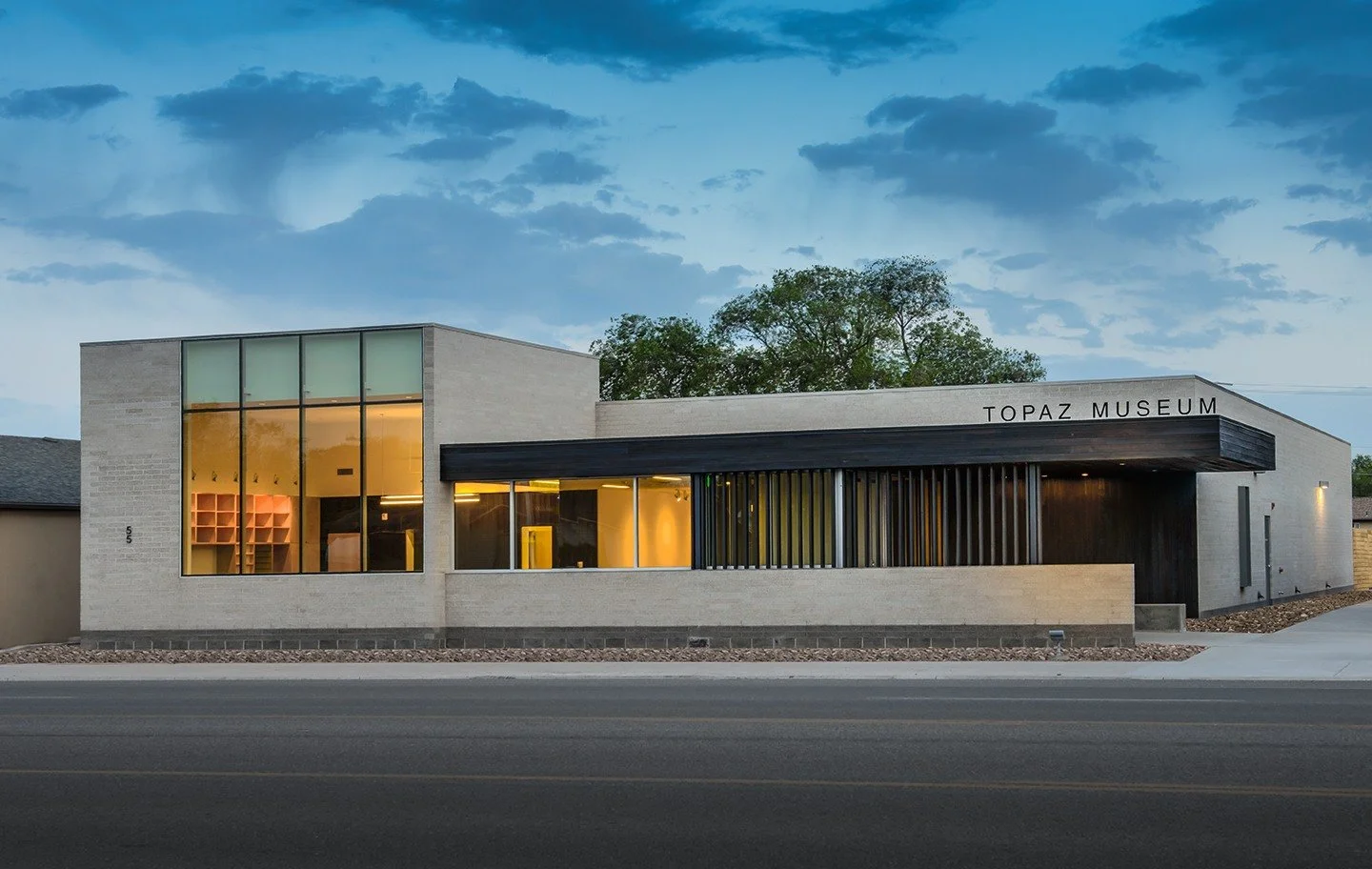
Designed by Sparano + Mooney Architecture, the Topaz Museum and Education Center is a 4,000 SF facility that provides information and interpretation regarding the thousands of Japanese Americans who were imprisoned at the nearby Topaz Camp during WWII. The Museum and Education Center helps prepare and encourage visitors to tour the Topaz Internment Camp site, located approximately 16 miles northwest of the Museum – it is located along Delta’s Main Street (Highway 50/6), providing maximum visibility for those traveling through.
The modern museum includes an exhibit space with interpretive displays, cutting-edge computer technology installations, artifacts and art from the Camp, a historically-accurate re-creation of one of the barracks, images of the Camp, and historic perspectives to engage and educate the public about the internment. In addition, the Museum also offers an education/orientation space, a secure curatorial storage area and an outdoor courtyard that includes a restored Recreation hall structure from the original Camp. Though the Camp was shuttered after WWII, the site became a National Historic Landmark in 2007, and evidence of its existence still remains – gardens, a gridded road network, walkways, concrete foundations, artifacts and other remnants that remind visitors of the injustice once inflicted. One of the primary goals of the project was to provide a secure home for some of these artifacts – the Museum’s collection comprises over 1,000 items – and to preserve the collection for future generations.
Mark Inouye is generously helping to advance the knowledge and understanding of the Topaz Camp and Museum, and we hope you will consider attending this important event. A pre-concert talk with Mark will begin at 6pm, and the show will begin at 7pm. The first set of symphonic music will be followed by an intermission, then a set of jazz. Finally, there will be a VIP Reception for Benefactor ticket holders at 9pm. Musicians Keisuke Nakagoshi, In Sun Jang, Jeffrey Budin, Brad Buethe, Mark Izu, Jeff Mars and Wendy Hanamura will join Mark in this musical storytelling event.
For more information, and to purchase tickets to the concert, please visit https://friendsoftopazfundraiser.com/ and http://www.topazmuseum.org/
Caine College of the Arts
CAINE COLLEGE OF THE ARTS ENGAGES STUDENTS IN DESIGN
JUNE 02, 2016
The Caine School of the Arts at Utah State University was first established in 2005. It became the Caine College of the Arts in 2010, with its own dean, Dr. Craig Jessop, and recognized degree programs for students in the design, theater, and music arts. Today the college is well known not only for its student body but also for the architecture that comprises the college campus. Sparano + Mooney Architecture is thrilled to be part of a campus-wide renovation project that will completely transform the Caine College of the Arts.
As a modern design firm based in California and Utah and specializing in contemporary architecture, we were immediately challenged by the opportunities Caine represents. But, upon meeting with school administration, it was decided we would not go into the project with a developed vision of our own. Rather, we would design the renovation around the needs and desires of faculty and students.
Such an approach to architecture is rare. It is not unusual for a firm like Sparano + Mooney Architecture to work with a small handful of individuals to come up with design plans, but to stretch that to hundreds of students and faculty is an entirely different matter. Yet we are committed to making sure their individual voices are heard. Not everyone will get everything they want, but we are doing our best to design new spaces that will best meet the needs of the majority of those who will actually use them.
MEETING WITH STUDENTS AND FACULTY
We began the design process last spring by holding a series of meetings to which we invited both faculty and students. The meetings were conducted as workshops, giving attendees an opportunity to express what they were hoping to see realized with the project. For example, there was a lot of concern about a lack of practice space for students. We will address that and many other spatial requirements through the expansion of the Fine Arts Complex.
The first phase of the renovation project is expected to last about 18 months, with completion in mid-2017. We have already seen significant progress on the addition and renovation of the Scene Shop, improvements to the Morgan Theater, and the interior transformation of the Kent Concert Hall. Much of our effort for 2016 will be concentrated on finishing up the Scene Shop and renovating the Tippets Gallery and some exterior courtyard areas. Overall, we believe the project is progressing nicely thanks to plenty of input from the University leadership, the faculty and students.
LOOKING TO FUTURE GENERATIONS
During our workshop discussions, we have heard plenty of great ideas about how the Fine Arts Complex could be improved, structurally and aesthetically. We heard lots of ideas about classroom space, creating more access to natural light, renovating performance space to be more inviting to patrons, and so on. But we were most impressed by the realization that so many students and faculty were as concerned about the future of the college as they are the present.
It is understood that a transformation of this nature might happen only once every few decades. The students and faculty at the Caine College of the Arts realize that the renovations done today will affect students for 20, 30, and even 40 years down the road. Those future generations of students should have campus facilities that enhance the learning atmosphere in both form and function. That is what we are striving for in this renovation.
Sparano + Mooney Architecture is a leading modern design firm in Utah and California that has had the privilege of working on some very exciting cultural projects. The project at the Caine College of the Arts has been, and continues to be, one of the most inspiring we have been involved with – thanks to the participation of the college leadership, and its students and faculty.
SOURCES
1. Utah Statesman – http://usustatesman.com/caine-college-of-the-arts-announces-plans-to-renovate-facilities/
SMA LOVES Central Ninth
SPARANO + MOONEY ARCHITECTURE LOVES CENTRAL NINTH
APRIL 15, 2016
Residential architecture in Salt Lake City is both intriguing and exciting at the same time. The city has a lot of great neighborhoods that, through the course of time and gentrification, have become a great place for us to live and work within. One example is the Central Ninth neighborhood close to the center of the city. We have had opportunities to work in this eclectic urban zone, including a recent project for which we designed a mixed-use housing project that combines the best in urban living with an inviting retail and public space.
We appreciate the opportunity to work on mixed-use projects such as this one because we know how important they are to metropolitan Salt Lake City. As a city with a strong and vibrant population of young professionals, Salt Lake City is one of the best places to live and work in the American West. Our urban zones that are being developed like the Central Ninth are a big part of that. Having an opportunity to contribute to urban zone developments has been an exciting challenge for Sparano + Mooney Architecture and one that we are happy to participate in as we create design solutions for these districts.
OUR MIXED-USE PROJECT
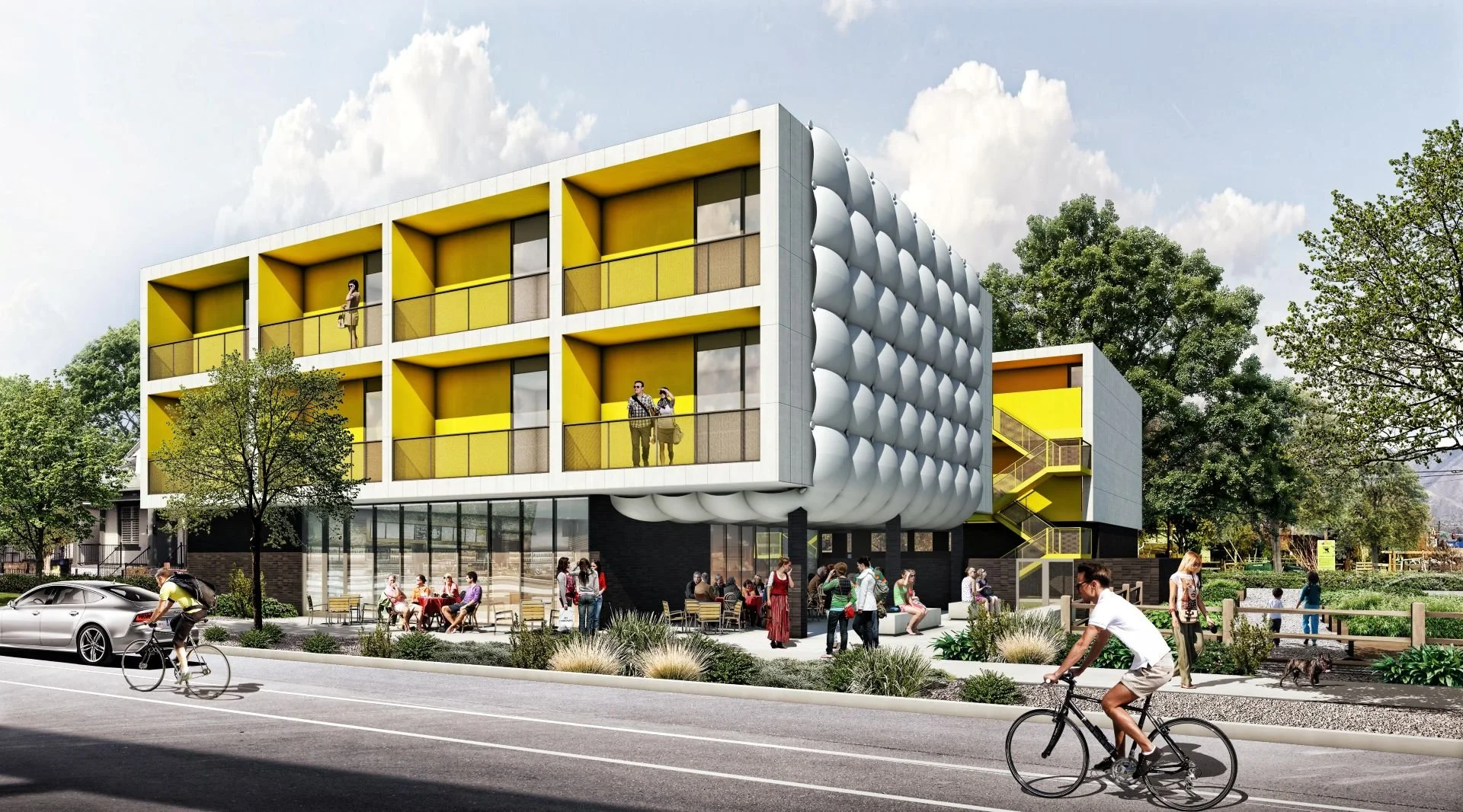
Our most recent contribution to the Central Ninth is for a fantastic site located just across from the TRAX station at 200 West. We designed the architecture and landscape around the concept of vibrant neighborhood living where people get to know one another and spend time socializing over a drink or a meal. Our design called for a mixed-use property combining quality housing units with a restaurant and retail space, tied together with public art and modern architecture. We designed a building that would be welcoming to both residents and visitors alike.
The building’s exterior is every bit modern architecture without compromise and fits within the overall atmosphere of the Central Ninth neighborhood. Our design proposal was one that fits in nicely with the neighborhood yet definitely attracts the eye as you travel down 200 West, on Trax, bicycle, car or on foot. On the first floor is residential and restaurant space, complete with integrated outdoor seating that creates a welcoming public space that invites social interaction.
Between buildings is a courtyard designed to be utilized by residents. It is an area with plenty of sunshine and ample green space with adjacent access to residential flex space where residents can entertain larger parties with a fully equipped kitchen and indoor and outdoor seating. We anticipate the open courtyard to be a place where residents meet and establish new friendships.
THE CENTRAL NINTH NEIGHBORHOOD
Each of the city's individual neighborhoods has its own style of residential architecture. In Salt Lake City, however, it's increasingly all about community living. From quaint, tree-lined boulevards to busy urban streets, people in the city want to feel connected with one another. That is what the revitalized Central Ninth is all about, too.
The neighborhood has an increasingly dense population of restaurants, cafes, coffee shops, and other places residents love to gather. On any given night you'll see people meeting after work to enjoy one another's company – outdoors when the weather is nice, indoors at other times. On the weekends, the streets of the Central Ninth come alive with activity.
The team at Sparano + Mooney Architecture had to really get to know the Central Ninth neighborhood in order to design a mixed-use project that would fit right in. It was a pleasure doing so. Some of our team lives there and the rest of us had the opportunity to meet some fantastic people, see the neighborhood for ourselves, and really get a feel for the vibe of the area. We believe our design project reflects that.
Residential architecture in Salt Lake City is just one of the many facets that make this city what it is and Sparano + Mooney Architecture is proud to be part of it.
Seamlessly Blending Old + New
PARK CITY HOME SEAMLESSLY BLENDS OLD AND NEW
MARCH 21, 2016
It's a dream come true: owning a beautiful vacation home that has direct access to the Park City Mountain Resort in northwest Utah. The Park City architects at Sparano + Mooney Architecture recently had the opportunity to make that dream a reality for a professional couple and their children. They hired us to design a modern vacation home that fits well in the mountain context, provided a comfortable and inspiring living environment, and met their goals of sustainability and environmental friendly architecture.
The design we came up with exceeded the expectations of everyone involved. From city planners in Park City to neighbors to the owners themselves, everyone our team had the opportunity to work with has contributed to the extraordinary result. Our client now has a beautifully crafted and highly functional vacation home where they can spend time in relaxing and enjoying all that Park City has to offer.
KEEPING IN TUNE WITH THE PAST
Property in Park City is somewhat unique, especially in the historic area of Old Town where our client’s purchased. Lots are compact and narrow, which was typical of the mining era, and many of them sit on steep slopes that can boast grades as steep as 40%. That said, the size and layout of the lot were just the beginning of the overall challenge our team faced. We also had to design a structure that was in keeping with the atmosphere of Park City’s Old Town.
Old Town has very strict architectural requirements when it comes to preserving the area's historical atmosphere. We were limited in our design, from everything from total structural height to the exterior materials we would use on the home. But our team of Park City architects worked with the Planning Commission to come up with an innovative design that satisfied everyone.
The resulting home does not duplicate the past in every detail. Rather, it is an ultra-modern structure that references and complements the past in a way that seamlessly blends both the contemporary and traditional. The house sits very naturally in the surrounding environment while still being modern. We believe it is one of the newest, yet most beautiful, contributing structures in Park City.
MEETING THE DEMANDS OF THE FUTURE
A primary goal of our clients was to build their vacation home to be not only aesthetically pleasing and comfortable but also one that was focused on sustainability and limited the environmental impact. These are things that are important to Sparano + Mooney Architecture as well, so this project was perfect for our residential team. We accepted the challenge of designing this house with a focus on sustainability that would meet or exceed the requirements for LEED certification.
We think we achieved what we set out to create: a beautiful Park City home that will be as good for the local environment as it is for the family that owns it. Our clients will enjoy years of comfortable relaxation in the beautiful mountain environment knowing that their home has a minimal environmental impact.
At the end of the day, the Park City vacation home is testament to the fact that we can design residential structures that incorporate the old with the new in a way that seamlessly blends the best of the past with the brightest aspects of the future. Past, present and future do not have to conflict – whether in aesthetic features or structural integrity. All three can be combined for a truly exceptionally finished product.
We wish our clients well in their new vacation home in Park City. We thoroughly enjoyed working on this property, knowing how much they would enjoy their time spent in such a lovely area.
AIA National Design Award
BEST ARCHITECTURE IN 2015 JUST ANNOUNCED BY FAITH AND FORM / NATIONAL AIA DESIGN AWARD
JANUARY 07, 2016
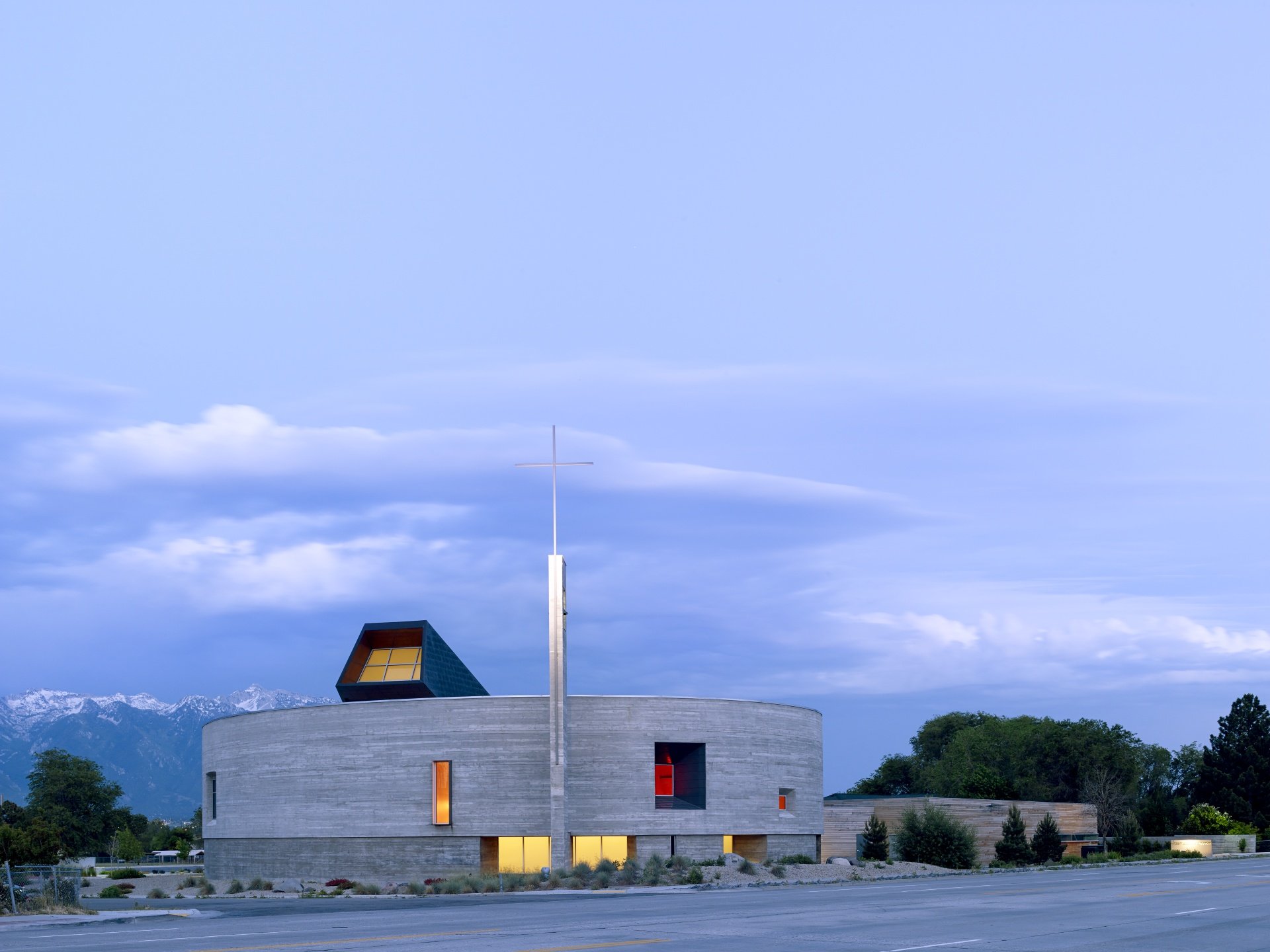
We are honored to have our design for Saint Joseph the Worker Catholic Church be recognized by Faith and Form Magazine and The AIA Interfaith Forum on Religion, Art and Architecture as one of the architects who are a national recipient of a 2015 Religious Architecture Award.
This design award recognizes exemplary sacred spaces of all denominations throughout the world. Check out this year’s architecture at Archdaily.